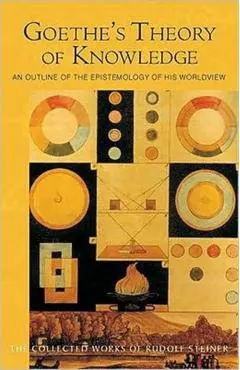
Goethe's Theory of Knowledge: An Outline of the Epistemology of His Worldview (Cw 2)
nWritten 1884-1885; first published 1886 (CW 2) As the editor of Goethe's scientific writings during the 1880s, Rudolf Steiner became immersed in a worldview that paralleled and amplified his own views in relat
Încă îl urmărimCum s-a mișcat prețul
Ce am observat noi
la minimToate cifrele de mai sus ies din ce am notat noi, în fiecare noapte. Nu le-am luat de nicăieri.
În fiecare zi luăm cel mai mic preț dintre toate magazinele și îl punem pe grafic. Linia verde e cel mai jos a coborât în ultima lună.
Lasă-ne adresa și îți scriem dacă scade sub —. Un singur e-mail, când chiar se întâmplă ceva. Îți cerem întâi o confirmare, și te poți retrage oricând dintr-un click.
Ce zice magazinul despre el
nWritten 1884-1885; first published 1886 (CW 2) As the editor of Goethe's scientific writings during the 1880s, Rudolf Steiner became immersed in a worldview that paralleled and amplified his own views in relation to epistemology, the interface between science and philosophy, the theory of how we know the world and ourselves. At the time, like much of the thinking today and the foundation of modern natural science, the predominant theories held that individual knowledge is limited to thinking that reflects objective, sensory perception. Steiner's view was eventually distilled in his Anthroposophical Leading Thoughts in 1924: There are those who believe that, with the limits of knowledge derived from sensory perception, the limits of all insight are given. Yet if they would carefully observe how they become conscious of these limits, they would find in the very consciousness of the limits the faculties to transcend them. In this concise volume, Steiner lays out his argument for this view and, moreover, begins his explication of how one goes beyond thinking to the observation of thinking itself. Goethe's Theory of Knowledge is essential reading for a deeper understanding of Rudolf Steiner's seminal work, Intuitive Thinking as a Spiritual Path: A Philosophy of Freedom. CONTENTS: Introduction by Christopher Bamford nPreface to the Edition of 1924 by Rudolf Steiner nForeword to the First Edition (1886) by Rudolf Steiner A. Preliminary Questions 1. The Point of Departure n2. Goethe's Science According to Schiller's Method n3. The Purpose of Our Science B. Experience 4. Establishing the Concept of Experience n5. Examining the Essence of Experience n6. Correcting the Erroneous View of Experience as a Totality n7. The Experience of Each Individual Reader C. Thinking 8. Thinking as a Higher Experience within Experience n9. Thinking and Consciousness n10. The Inner Nature of Thinking D. Knowledge 11. Thought and Perception n12. Intellect and Reason n13. The Act of Cognition n14. Cognition and the Ultimate Ground of Things E. Knowing Nature 15. Inorganic Nature n16. Organic Nature F. The Humanities 17. Introduction: Mind and Nature n18. Psychological Cognition n19. Human Freedom n20. Optimism and Pessimism G. Conclusion 21. Knowledge and Artistic Creation Notes to the First Edition 1886] nAnnotations to the Edition of 1924 This volume is a translation from the German of Grundlinien einer Erkenntnistheorie der Goethesc
Descrierea e luată de la Libris.
Alte cărți de Rudolf Steiner




Produse similare din Psihologie & filosofie
Vezi categoria →