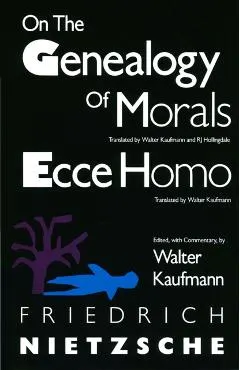
On the Genealogy of Morals and Ecce Homo
nThe great philosopher's major work on ethics, along with Ecce Homo, Nietzche's remarkable review of his life and works.
Încă îl urmărimCum s-a mișcat prețul
Ce am observat noi
la minimToate cifrele de mai sus ies din ce am notat noi, în fiecare noapte. Nu le-am luat de nicăieri.
În fiecare zi luăm cel mai mic preț dintre toate magazinele și îl punem pe grafic. Linia verde e cel mai jos a coborât în ultima lună.
Lasă-ne adresa și îți scriem dacă scade sub —. Un singur e-mail, când chiar se întâmplă ceva. Îți cerem întâi o confirmare, și te poți retrage oricând dintr-un click.
Ce zice magazinul despre el
nThe great philosopher's major work on ethics, along with Ecce Homo, Nietzche's remarkable review of his life and works. On the Genealogy of Morals (1887) shows him using philsophy, psychology, and classical philology in an effort to give new direction to an ancient discipline. nThe work consists of three essays. The first contrasts master morality and slave morality and indicates how the term good has widely different meanings in each. The second inquiry deals with guilt and the bad conscience; the third with ascetic ideals--not only in religion but also in the academy. n Ecce Homo, written in 1898 and first published posthumously in 1908, is Nietzsche's review of his life and works. It contains chapters on all the books he himself published. His interpretations are as fascinating as they are invaluable. Nothing Nietzsche wrote is more stunning stylistically or as a human document. n Walter Kaufmann's masterful translations are faithful of the word and spirit of Nietzsche, and his running footnote commentaries on both books are more comprehensive than those in his other Nietzsche translations because these tow works have been so widely misunderstood. nThe great philosopher's major work on ethics, along with Ecce Homo, Nietzche's remarkable review of his life and works. On the Genealogy of Morals (1887) shows him using philsophy, psychology, and classical philology in an effort to give new direction to an ancient discipline. nThe work consists of three essays. The first contrasts master morality and slave morality and indicates how the term good has widely different meanings in each. The second inquiry deals with guilt and the bad conscience; the third with ascetic ideals--not only in religion but also in the academy. n Ecce Homo, written in 1898 and first published posthumously in 1908, is Nietzsche's review of his life and works. It contains chapters on all the books he himself published. His interpretations are as fascinating as they are invaluable. Nothing Nietzsche wrote is more stunning stylistically or as a human document. n Walter Kaufmann's masterful translations are faithful of the word and spirit of Nietzsche, and his running footnote commentaries on both books are more comprehensive than those in his other Nietzsche translations because these tow works have been so widely misunderstood. nThe great philosopher's major work on ethics, along with Ecce Homo, Nietzche's remarkable review of his life and works. On the Genealogy
Descrierea e luată de la Libris.
Alte cărți de Friedrich Wilhelm Nietzsche
Produse similare din Psihologie & filosofie
Vezi categoria →