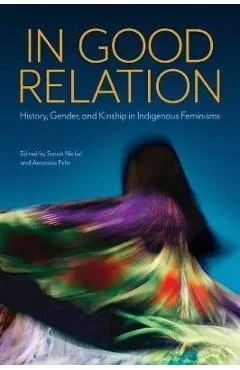
In Good Relation: History, Gender, and Kinship in Indigenous Feminisms
nOver the past thirty years, a strong canon of Indigenous feminist literature has addressed how Indigenous women are uniquely and dually affected by colonialism and patriarchy.
Încă îl urmărimCum s-a mișcat prețul
Deocamdată n-avem ce desena — mai lăsăm câteva zile de notat și apare graficul.
Ce am observat noi
la minimToate cifrele de mai sus ies din ce am notat noi, în fiecare noapte. Nu le-am luat de nicăieri.
În fiecare zi luăm cel mai mic preț dintre toate magazinele și îl punem pe grafic. Linia verde e cel mai jos a coborât în ultima lună.
Lasă-ne adresa și îți scriem dacă scade sub —. Un singur e-mail, când chiar se întâmplă ceva. Îți cerem întâi o confirmare, și te poți retrage oricând dintr-un click.
Ce zice magazinul despre el
nOver the past thirty years, a strong canon of Indigenous feminist literature has addressed how Indigenous women are uniquely and dually affected by colonialism and patriarchy. Indigenous women have long recognized that their intersectional realities were not represented in mainstream feminism, which was principally white, middle-class, and often ignored realities of colonialism. As Indigenous feminist ideals grew, Indigenous women became increasingly multi-vocal, with multiple and oppositional understandings of what constituted Indigenous feminism and whether or not it was a useful concept. Emerging from these dialogues are conversations from a new generation of scholars, activists, artists, and storytellers who accept the usefulness of Indigenous feminism and seek to broaden the concept. In Good Relation captures this transition and makes sense of Indigenous feminist voices that are not necessarily represented in existing scholarship. There is a need to further Indigenize our understandings of feminism and to take the scholarship beyond a focus on motherhood, life history, or legal status (in Canada) to consider the connections between Indigenous feminisms, Indigenous philosophies, the environment, kinship, violence, and Indigenous Queer Studies. Organized around the notion of generations, this collection brings into conversation new voices of Indigenous feminist theory, knowledge, and experience. Taking a broad and critical interpretation of Indigenous feminism, it depicts how an emerging generation of artists, activists, and scholars are envisioning and invigorating the strength and power of Indigenous women.
Descrierea e luată de la Libris.
Produse similare din Istorie & societate
Vezi categoria →