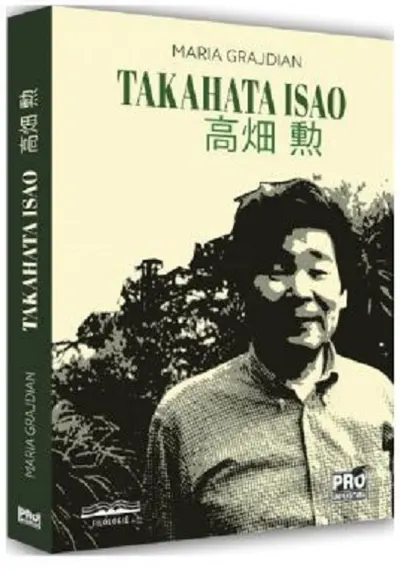
Takahata Isao
Takahata Isao (1935-2018) was the co-founder of Studio Ghibli, the world-famous Japanese animation enterprise since 1985.
La cel mai bun preț din ultima lună (33,00 lei)Unde cât costă
| Magazin | Preț | Istoric | |
|---|---|---|---|
CĂ Cărturești |
33,00 lei | la minimul propriu | Vezi în magazin |
Prețurile vin automat din listele magazinelor și se mai schimbă între timp. Cel care contează e cel din coșul magazinului, la plată. Linkurile către magazine sunt de parteneriat: dacă cumperi, luăm un comision de la magazin. Pe tine nu te costă nimic în plus, iar ordinea de mai sus e strict după preț.
Cum s-a mișcat prețul
Ce am observat noi
la minimToate cifrele de mai sus ies din ce am notat noi, în fiecare noapte. Nu le-am luat de nicăieri.
În fiecare zi luăm cel mai mic preț dintre toate magazinele și îl punem pe grafic. Linia verde e cel mai jos a coborât în ultima lună.
Lasă-ne adresa și îți scriem dacă scade sub 33,00 lei. Un singur e-mail, când chiar se întâmplă ceva. Îți cerem întâi o confirmare, și te poți retrage oricând dintr-un click.
Întrebări frecvente
Cât costă Takahata Isao?
Cel mai ieftin îl găsești la Cărturești, cu 33,00 lei. Verificăm cifra în fiecare zi, direct din lista de prețuri a magazinului.
Este reducerea la Takahata Isao una reală?
Nu chiar. Costă 33,00 lei, adică exact cât l-am văzut cel mai ieftin în ultima lună. Nu e o scădere nouă — dar nici nu plătești mai mult decât cei care au prins momentul bun.
Care a fost cel mai mic preț la Takahata Isao?
Cel mai ieftin l-am prins la 33,00 lei — adică exact cât costă azi. Îl urmărim de 16 zile.
Ce zice magazinul despre el
Takahata Isao (1935-2018) was the co-founder of Studio Ghibli, the world-famous Japanese animation enterprise since 1985. Together with Miyazaki Hayao (born 1942), Takahata Isao uniquely impacted the world of animation – Japanese and beyond –, both aesthetically and ideologically. On the pursuit of what he called “l’invention du reel dans l’animation” (“the invention of the real in animation”), Takahata Isao sought to establish the ability of animation to recreate rather than to represent reality, so that the bi-dimensionality of animation reflects and transcends the multi-dimensionality of life. Throughout his activity as an animation director, his efforts towards realism are ultimately replaced through experiments to simplify representation in his last two animation films – an aesthetic attitude revealing Takahata’s preoccupation with the dialectic interaction between reality and representation, which challenges classical understandings of “beauty” and “ugliness”: Cuteness respectively the tendency towards “cutification” in (Japanese) animation is to be comprehended as a proactive confrontation with socio-cultural cliches which do not allow for deviation from the norm or for expansion of one’s own individual potential. From an ideological perspective, Takahata Isao viewed community as human solidarity and social cohesion in their functions as fundamental premises for harmony and co-existence. The continuity of life despite losses and death highlighted the fact that life is the most important asset one possesses and could ever possess, with death appearing as solely a transition into another dimension of co-existence with nature and the universe. His vision of “deep ecology” acknowledges the embedding of the human being within a complex network of inter-dependences and necessities with non-human entities as well as the compelling obligation to find ways to cooperate with them respectively to learn to live in harmony and creative cooperation with their very existences. Last but not least, Takahata’s warm humanism, which encloses love and hope as highest commandments, might oftentimes come across to audiences as sarcasm, biting irony or down-to-earth humor, as cruel mocking of those described – however, at a closer look, a very profound sense of compassion eclipses any illusions of cynicism.
Descrierea e luată de la Cărturești.
Produse similare din Cărți în limbi străine
Vezi categoria →