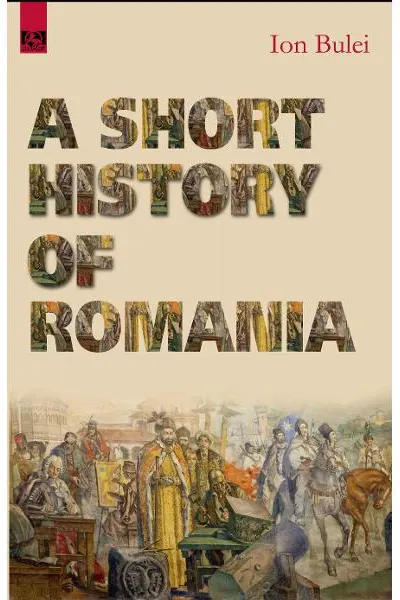
A Short History of Romania
A history of Romanians in a nutshell, to the point and marking the essential.
La cel mai bun preț din ultima lună (47,25 lei)Unde cât costă
| Magazin | Preț | Istoric | |
|---|---|---|---|
CĂ Cărturești |
47,25 lei | la minimul propriu | Vezi în magazin |
Prețurile vin automat din listele magazinelor și se mai schimbă între timp. Cel care contează e cel din coșul magazinului, la plată. Linkurile către magazine sunt de parteneriat: dacă cumperi, luăm un comision de la magazin. Pe tine nu te costă nimic în plus, iar ordinea de mai sus e strict după preț.
Cum s-a mișcat prețul
Ce am observat noi
la minimToate cifrele de mai sus ies din ce am notat noi, în fiecare noapte. Nu le-am luat de nicăieri.
În fiecare zi luăm cel mai mic preț dintre toate magazinele și îl punem pe grafic. Linia verde e cel mai jos a coborât în ultima lună.
Lasă-ne adresa și îți scriem dacă scade sub 47,25 lei. Un singur e-mail, când chiar se întâmplă ceva. Îți cerem întâi o confirmare, și te poți retrage oricând dintr-un click.
Întrebări frecvente
Cât costă A Short History of Romania?
Cel mai ieftin îl găsești la Cărturești, cu 47,25 lei. Verificăm cifra în fiecare zi, direct din lista de prețuri a magazinului.
Este reducerea la A Short History of Romania una reală?
Nu chiar. Costă 47,25 lei, adică exact cât l-am văzut cel mai ieftin în ultima lună. Nu e o scădere nouă — dar nici nu plătești mai mult decât cei care au prins momentul bun.
Care a fost cel mai mic preț la A Short History of Romania?
Cel mai ieftin l-am prins la 47,25 lei — adică exact cât costă azi. Îl urmărim de 17 zile.
Ce zice magazinul despre el
A history of Romanians in a nutshell, to the point and marking the essential.
A history of Romanians in the overall European context.
Flexible approach, vivid, clear writing.
Answering the author’s questions, it hopefully meets readers’ interest, too.
Fine reading for everyone.
Fragment din carte:"• Wallachia was the second Romanian territory under direct Ottoman threat. Thanks to the efforts made by Vlaicu (Vladislav I, 1364—about 1376) and, especially, by Mircea the Old (1386-1418), the Ottoman advance, which had reached the Danube, was stopped. In 1395, Bayazid crossed the Danube, but the incursion ended with Mircea the Old's victory in the battle of Rovine. Laonicus Chalcocondyles, a Byzantine chronicler, described the battle as follows: "Mircea had gathered his army, yet he did not plan to attack but carefully took the women and children to the hills of Brasov to shelter them. After that he and his army started following Bayazid through the thick oak trees that cover most of the country and make it difficult for the enemies to pass through or to win a victory. And during that time he performed feats worth to be remembered, fighting with enemy units that were wandering in search of food or for stealing cattle; he courageously followed Bayazid and brilliantly fought him." The battle was fought at a place (Rovine) strengthened with ditches. The chronicle writes that the river crossing the battlefield was "red, like the blood flowing from the fallen bodies." It was the first resounding victory of the Romanians in the fight against the Turks. In 1396, Mircea participated in the European knights' crusade at Nicopolis. The knights rejected the battle tactics advanced by Mircea and the crusade was crushed by the Ottomans. Meanwhile, in the autumn and winter of 1395-96, Mircea was confronted with the attempts made by Vlad, a relative, supported by the Poles, to usurp his throne. That was also the time when Wallachia concluded the first capitulation with the Ottoman Porte, whereby the country preserved its autonomy but paid a tribute and acknowledged the Ottoman suzerainty. In 1402 Mircea the Old took advantage of the Ottomans' defeat at Ankara by Tamerlane and interfered in the struggle for succession in the Ottoman Empire. In 1404 he reoccupied Dobruja and defeated the Ottoman army at Silistra. It was the apex of his rule. No other Wallachian prince would ever be able to assume the titles Mircea attached to his name: "Mircea, prince and ruler, by God's mercy and will, master and ruler of the entire country of Ungrovlahia, of the regions beyond the mountains, and even the Tartar places, of Amlas and Fagaras, and prince of the Banat of Severin and on both sides of the entire Podunavia, even as far as the Great Sea, and also the master of Darstor fortress." Together with Stefan Lazarevic, prince of Serbia, Mircea supported Musa, who removed Suleiman in 1411 but, in his turn, was defeated by Mehmed in 1413. Then, he extended his support to Mustapha and he was unlucky again, as Mehmed I won the...
Descrierea e luată de la Cărturești.
Alte cărți de Ion Bulei

Produse similare din Cărți în limbi străine
Vezi categoria →