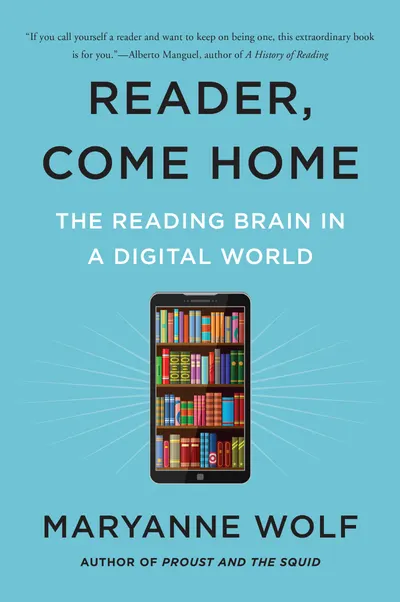
Reader, Come Home
The author of the acclaimed Proust and the Squid follows up with a lively, ambitious, and deeply informative book that considers the future of the reading brain and our capacity for critical thinking, empathy,
La cel mai bun preț din ultima lună (45,00 lei)Unde cât costă
| Magazin | Preț | Istoric | |
|---|---|---|---|
CĂ Cărturești |
45,00 lei | la minimul propriu | Vezi în magazin |
Prețurile vin automat din listele magazinelor și se mai schimbă între timp. Cel care contează e cel din coșul magazinului, la plată. Linkurile către magazine sunt de parteneriat: dacă cumperi, luăm un comision de la magazin. Pe tine nu te costă nimic în plus, iar ordinea de mai sus e strict după preț.
Cum s-a mișcat prețul
Ce am observat noi
la minimToate cifrele de mai sus ies din ce am notat noi, în fiecare noapte. Nu le-am luat de nicăieri.
În fiecare zi luăm cel mai mic preț dintre toate magazinele și îl punem pe grafic. Linia verde e cel mai jos a coborât în ultima lună.
Lasă-ne adresa și îți scriem dacă scade sub 45,00 lei. Un singur e-mail, când chiar se întâmplă ceva. Îți cerem întâi o confirmare, și te poți retrage oricând dintr-un click.
Întrebări frecvente
Cât costă Reader, Come Home?
Cel mai ieftin îl găsești la Cărturești, cu 45,00 lei. Verificăm cifra în fiecare zi, direct din lista de prețuri a magazinului.
Este reducerea la Reader, Come Home una reală?
Nu chiar. Costă 45,00 lei, adică exact cât l-am văzut cel mai ieftin în ultima lună. Nu e o scădere nouă — dar nici nu plătești mai mult decât cei care au prins momentul bun.
Care a fost cel mai mic preț la Reader, Come Home?
Cel mai ieftin l-am prins la 45,00 lei — adică exact cât costă azi. Îl urmărim de 20 zile.
Ce zice magazinul despre el
The author of the acclaimed Proust and the Squid follows up with a lively, ambitious, and deeply informative book that considers the future of the reading brain and our capacity for critical thinking, empathy, and reflection as we become increasingly dependent on digital technologies.
A decade ago, Maryanne Wolf’s Proust and the Squid revealed what we know about how the brain learns to read and how reading changes the way we think and feel. Since then, the ways we process written language have changed dramatically with many concerned about both their own changes and that of children. New research on the reading brain chronicles these changes in the brains of children and adults as they learn to read while immersed in a digitally dominated medium.
Drawing deeply on this research, this book comprises a series of letters Wolf writes to us―her beloved readers―to describe her concerns and her hopes about what is happening to the reading brain as it unavoidably changes to adapt to digital mediums. Wolf raises difficult questions, including:
Will children learn to incorporate the full range of "deep reading" processes that are at the core of the expert reading brain?
Will the mix of a seemingly infinite set of distractions for children’s attention and their quick access to immediate, voluminous information alter their ability to think for themselves?
With information at their fingertips, will the next generation learn to build their own storehouse of knowledge, which could impede the ability to make analogies and draw inferences from what they know?
Will all these influences, in turn, change the formation in children and the use in adults of "slower" cognitive processes like critical thinking, personal reflection, imagination, and empathy that comprise deep reading and that influence both how we think and how we live our lives?
Will the chain of digital influences ultimately influence the use of the critical analytical and empathic capacities necessary for a democratic society?
How can we preserve deep reading processes in future iterations of the reading brain?
Who are the "good readers" of every epoch?
Concerns about attention span, critical reasoning, and over-reliance on technology are never just about children―Wolf herself has found that, though she is a reading expert, her ability to read deeply has been impacted as she has become, inevitably, increasingly dependent on screens.
Wolf draws on neuroscience, literature, education, technology, and philosophy and blends historical, literary, and scientific facts with down-to-earth examples and warm anecdotes to illuminate complex ideas that culminate in a proposal for a biliterate reading brain. Provocative and intriguing, Reader, Come Home is a roadmap that provides a cautionary but hopeful perspective on the impact of technology on our brains and our most essential intellectual capacities―and what this could mean for our future.
Descrierea e luată de la Cărturești.
Alte cărți de Maryanne Wolf
Produse similare din Cărți în limbi străine
Vezi categoria →