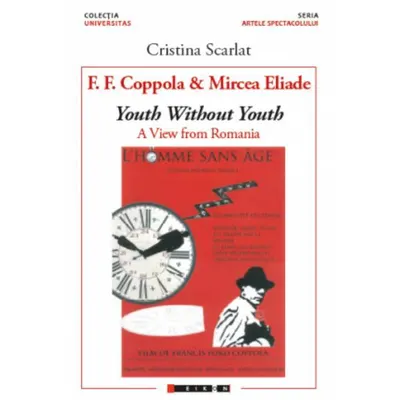
F.F. Coppola and Mircea Eliade - Youth without youth
F.F. Coppola and Mircea Eliade - Cristina Scarlat, editura Eikon: If I have the gift of prophecy and can fathom all mysteries and all knowledge, and if I have a faith that can move mountains, but do not have…
La cel mai bun preț din ultima lună (25,00 lei)Unde cât costă
| Magazin | Preț | Istoric | |
|---|---|---|---|
CĂ Cărturești |
25,00 lei | la minimul propriu | Vezi în magazin |
Prețurile vin automat din listele magazinelor și se mai schimbă între timp. Cel care contează e cel din coșul magazinului, la plată. Linkurile către magazine sunt de parteneriat: dacă cumperi, luăm un comision de la magazin. Pe tine nu te costă nimic în plus, iar ordinea de mai sus e strict după preț.
Cum s-a mișcat prețul
Ce am observat noi
la minimToate cifrele de mai sus ies din ce am notat noi, în fiecare noapte. Nu le-am luat de nicăieri.
În fiecare zi luăm cel mai mic preț dintre toate magazinele și îl punem pe grafic. Linia verde e cel mai jos a coborât în ultima lună.
Lasă-ne adresa și îți scriem dacă scade sub 25,00 lei. Un singur e-mail, când chiar se întâmplă ceva. Îți cerem întâi o confirmare, și te poți retrage oricând dintr-un click.
Întrebări frecvente
Cât costă F.F. Coppola and Mircea Eliade - Youth without youth?
Cel mai ieftin îl găsești la Cărturești, cu 25,00 lei. Verificăm cifra în fiecare zi, direct din lista de prețuri a magazinului.
Este reducerea la F.F. Coppola and Mircea Eliade - Youth without youth una reală?
Nu chiar. Costă 25,00 lei, adică exact cât l-am văzut cel mai ieftin în ultima lună. Nu e o scădere nouă — dar nici nu plătești mai mult decât cei care au prins momentul bun.
Care a fost cel mai mic preț la F.F. Coppola and Mircea Eliade - Youth without youth?
Cel mai ieftin l-am prins la 25,00 lei — adică exact cât costă azi. Îl urmărim de 20 zile.
Ce zice magazinul despre el
F.F. Coppola and Mircea Eliade - Cristina Scarlat, editura Eikon: If I have the gift of prophecy and can fathom all mysteries and all knowledge, and if I have a faith that can move mountains, but do not have love, I am nothing. (St. Paul’s “Th e first epistle to the Corinthians”). This is the guiding thread of both, the text and the movie, the key and the measure of the whole.
Dominic lives the Christian experience, death and resurrection. Struck by thunder the lead character evolves in the eternal present of Resurrection and remains in history at the same time. Th e final return to the time and history from which he “broke off ” at the moment of the accident represents the return home to die. Dominic’s into becoming signifies the improvement or the retouch of some destiny loops, his growing into a spiritual human being, his work being the very human being improved, evolved and superior after the initiatory experience caused by the accident. It is the Prince Charming from our folk tales who, after a series of initiatory experiences that positioned him on “the way” in order to build his own path, returns to the “womb“ improved and discharmed. Cristina ScarlatThe entire film swings through the possibilities offered to us through study and research, only to confess that without love (eros), or compassion (agape/bhakti), you’re as good as dead anyway (cf. Cor. 13, 2). And perhaps it was this idea that drew me to Eliade and Coppola more than anything.
Cristina Scarlat’s work is the ideal guide to the interface between Eliade, Coppola and the reader or viewer of this complex story. Here is a work nourished by dedicated passion, painstaking erudition and balanced judgment. I cannot refrain from indicating the high points of this brief but dense essay. These are the theoretical discussion of semiotics of arts/media and intertextuality, the reconstruction of the interplay between the narrator Eliade and the filmmaker Coppola (who most oft en speaks in first person), the vast (quasi exhaustive) survey of the critical reception in the (French, Italian, Romanian, American) press and in academic scholarship (Ricketts, Kripal, Biles, Garzilli, Calinescu, Simion, Groza, Glodeanu), not to mention a series of personal vivid and convincing interpretations and explanations, especially frequent in the final part. I cannot but share the conclusive remark (quite similar to my own conclusion in an interview given to “Mama Studio”): “Finally, the meaning of the text may be recovered starting backwards from its cinematographic transposition.” - Professor Giovanni Casadio History of Religions Department, University of Salerno, Italy
Descrierea e luată de la Cărturești.
Produse similare din Cărți în limbi străine
Vezi categoria →