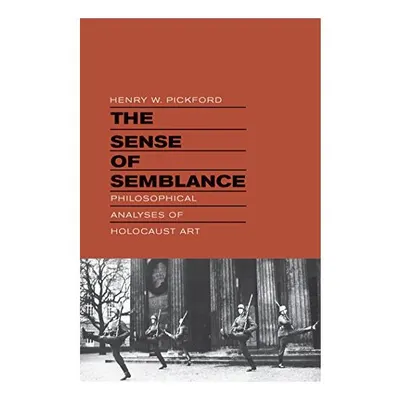
The sense of semblance
"Holocaust artworks intuitively must fulfill at least two criteria: artistic (lest they be merely historical documents) and historical (lest they distort the Holocaust or become merely artworks).
Încă îl urmărimCum s-a mișcat prețul
Ce am observat noi
la minimToate cifrele de mai sus ies din ce am notat noi, în fiecare noapte. Nu le-am luat de nicăieri.
În fiecare zi luăm cel mai mic preț dintre toate magazinele și îl punem pe grafic. Linia verde e cel mai jos a coborât în ultima lună.
Lasă-ne adresa și îți scriem dacă scade sub —. Un singur e-mail, când chiar se întâmplă ceva. Îți cerem întâi o confirmare, și te poți retrage oricând dintr-un click.
Ce zice magazinul despre el
"Holocaust artworks intuitively must fulfill at least two criteria: artistic (lest they be merely historical documents) and historical (lest they distort the Holocaust or become merely artworks). The Sense of Semblance locates this problematic within philosophical aesthetics, as a version of the conflict between aesthetic autonomy and heteronomy, and argues that Adorno's dialectic of aesthetic semblance describes the normative demand that artworks maintain a dynamic tension between the two. The Sense of Semblance aims to move beyond familiar debates surrounding postmodernism by demonstrating the usefulness of contemporary theories of meaning and understanding, including those from the analytic tradition. Pickford shows how the causal theory of names, the philosophy of tacit knowledge, the analytic philosophy of quotation, Sartre's theory of the imaginary, the epistemology of testimony, and Walter Benjamin's dialectical image can help explicate how individual artworks fulfill artistic and historical desiderata. In close readings of Celan's poetry, Holocaust memorials in Berlin, the quotational artist Heimrad Backer, Claude Lanzmann's film Shoah, and Art Spiegelman's graphic novel Maus, Pickford offers interpretations that, in their precision, specificity, and clarity, inaugurate a dialogue between contemporary analytic philosophy and contemporary art. The Sense of Semblance is the first book to incorporate contemporary analytic philosophy in interpretations of art and architecture, literature, and film about the Holocaust"--"Drawing on work in contemporary analytic philosophy and Adorno's normative aesthetic theory, this book aims to show how selected Holocaust artworks in a variety of media (lyric poetry by Paul Celan, Holocaust memorials, quotational texts by Heimr...
Descrierea e luată de la Anticexlibris.
Produse similare din Istorie & societate
Vezi categoria →