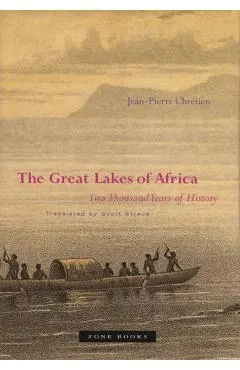
The Great Lakes of Africa: Two Thousand Years of History
Drawing on colonial archives, oral tradition, archeological discoveries, anthropologic and linguistic studies, and his thirty years of scholarship, Jean-Pierre Chretien offers a major synthesis of the history…
Încă îl urmărimCum s-a mișcat prețul
Ce am observat noi
la minimToate cifrele de mai sus ies din ce am notat noi, în fiecare noapte. Nu le-am luat de nicăieri.
În fiecare zi luăm cel mai mic preț dintre toate magazinele și îl punem pe grafic. Linia verde e cel mai jos a coborât în ultima lună.
Lasă-ne adresa și îți scriem dacă scade sub —. Un singur e-mail, când chiar se întâmplă ceva. Îți cerem întâi o confirmare, și te poți retrage oricând dintr-un click.
Ce zice magazinul despre el
Drawing on colonial archives, oral tradition, archeological discoveries, anthropologic and linguistic studies, and his thirty years of scholarship, Jean-Pierre Chretien offers a major synthesis of the history of the region, one still plagued by extremely violent wars. n nAlthough the genocide of 1994 catapulted Rwanda onto the international stage, English-language historical accounts of the Great Lakes region of Eastern Africa are still scarce. Drawing on a wide range of sources -- colonial archives, oral tradition, archaeological discoveries, studies in anthropology and linguistics, and his thirty years of scholarship -- Jean-Pierre Chrétien offers a major synthesis of the history of the region, which encompasses Rwanda, Burundi, Uganda, Eastern Congo, and Western Tanzania, a region still plagued by extremely violent wars. n nThe Great Lakes of Africa: Two Thousand Years of History first retraces the human settlement and the formation of kingdoms around the sources of the Nile, which were discovered by European explorers around 1860. Chrétien then describes these kingdoms' complex social and political organization and analyzes how the colonizers -- German, British, and Belgian -- not only transformed and exploited the existing power structures, but also projected their own racial categories onto them. n nFinally, the author shows how the independent states of the postcolonial era, in particular Rwanda, Burundi, and Uganda, have been trapped by their colonial and precolonial legacies, and especially by the racial rewriting of the latter by the former. Today, argues Chrétien, the Great Lakes region of Africa is crucial for historical research: not only because its history is particularly fascinating but also because the tragedies of its present are very much a function of the political manipulations of its past.n
Descrierea e luată de la Libris.
Produse similare din Istorie & societate
Vezi categoria →