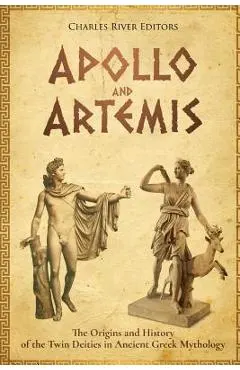
Apollo and Artemis: The Origins and History of the Twin Deities in Ancient Greek Mythology
*Includes pictures n*Includes ancient accounts n*Includes online resources and a bibliography for further reading nApollo's history is a confusing one, said the renowned poet and mythologist Robert Graves.
Încă îl urmărimCum s-a mișcat prețul
Ce am observat noi
la minimToate cifrele de mai sus ies din ce am notat noi, în fiecare noapte. Nu le-am luat de nicăieri.
În fiecare zi luăm cel mai mic preț dintre toate magazinele și îl punem pe grafic. Linia verde e cel mai jos a coborât în ultima lună.
Lasă-ne adresa și îți scriem dacă scade sub —. Un singur e-mail, când chiar se întâmplă ceva. Îți cerem întâi o confirmare, și te poți retrage oricând dintr-un click.
Ce zice magazinul despre el
*Includes pictures n*Includes ancient accounts n*Includes online resources and a bibliography for further reading nApollo's history is a confusing one, said the renowned poet and mythologist Robert Graves. This notion is also illustrated in the above quote from the 6th century BCE Homeric Hymn to Apollo, which gives the reader a brief glimpse into the confusion surrounding Apollo's multi-faceted nature. The quote comes from the end of an episode in which Apollo is traversing the known world, looking for a place to build a temple to himself. Once he lands upon a place of his liking, however, he realizes that he needs to populate it with priests who would 'guard' and care for its ceremonies. Rather than depend upon those 'glorious tribes' to supply his temple with sycophants, Apollo has no patience for chance, and flies down to a Cretan merchant ship, landing on it in the form of a timber-shaking dolphin. After terrifying the merchants, he tells them that their lives in the sea trade are over, and they are to be priests at his temple from then on. Cautioning the merchants to eschew piracy and 'keep righteousness' in their hearts, while simultaneously confronting and sequestering them captures the youthful god's capricious character quite well.
Of course, the rest of the ancient Greek gods were certainly not above hypocrisy - the adultery of Zeus alone demonstrates that - but Apollo was a brash contrarian in the face of all divine order. Unlike many of the other Olympian gods, Apollo's nature changed dramatically at the closing of his adolescence. His twin sister Artemis, in direct comparison with Apollo, immediately leapt to her mother's aide as midwife to her brother after she was born. Artemis would continue to be a goddess of midwives, while Apollo's role would continue to evolve over centuries. nUltimately, any 21st century study of a mythological being must gather together as many strands of learning as possible in order to formulate a useful hypothesis. In the case of Apollo, these strands are expansive, permeative, and international, and at first blush, they can seem very confusing indeed. An important thing to bear in mind when approaching Apollo is that his role in the ancient Greek pantheon was eclectic, even by contemporary standards, and the expansion of Greek culture to other parts of the Mediterranean only served to compound his identity even further. The story of Apollo is an excellent example of how stories and characters can chang
Descrierea e luată de la Libris.
Produse similare din Istorie & societate
Vezi categoria →