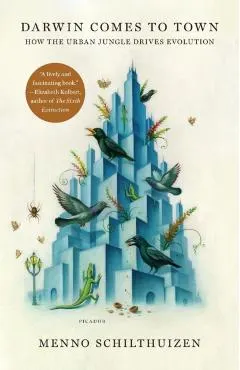
Darwin Comes to Town: How the Urban Jungle Drives Evolution
n nFrom evolutionary biologist Menno Schilthuizen, a book that will make you see yourself and the world around you in an entirely new way n n*Carrion crows in the Japanese city of Sendai have learned to use pas
A fost și mai ieftin — l-am prins la 109,07 leiCum s-a mișcat prețul
Ce am observat noi
peste minimToate cifrele de mai sus ies din ce am notat noi, în fiecare noapte. Nu le-am luat de nicăieri.
În fiecare zi luăm cel mai mic preț dintre toate magazinele și îl punem pe grafic. Linia verde e cel mai jos a coborât în ultima lună.
Lasă-ne adresa și îți scriem dacă scade sub —. Un singur e-mail, când chiar se întâmplă ceva. Îți cerem întâi o confirmare, și te poți retrage oricând dintr-un click.
Ce zice magazinul despre el
n nFrom evolutionary biologist Menno Schilthuizen, a book that will make you see yourself and the world around you in an entirely new way n n*Carrion crows in the Japanese city of Sendai have learned to use passing traffic to crack nuts.n n*Lizards in Puerto Rico are evolving feet that better grip surfaces like concrete.n n*Europe's urban blackbirds sing at a higher pitch than their rural cousins, to be heard over the din of traffic.n nHow is this happening?n nMenno Schilthuizen is one of a growing number of urban ecologists studying how our manmade environments are accelerating and changing the evolution of the animals and plants around us. In Darwin Comes to Town, he takes us around the world for an up-close look at just how stunningly flexible and swift-moving natural selection can be.n nWith human populations growing, we're having an increasing impact on global ecosystems, and nowhere do these impacts overlap as much as they do in cities. The urban environment is about as extreme as it gets, and the wild animals and plants that live side-by-side with us need to adapt to a whole suite of challenging conditions: they must manage in the city's hotter climate (the urban heat island); they need to be able to live either in the semidesert of the tall, rocky, and cavernous structures we call buildings or in the pocket-like oases of city parks (which pose their own dangers, including smog and free-rangingdogs and cats); traffic causes continuous noise, a mist of fine dust particles, and barriers to movement for any animal that cannot fly or burrow; food sources are mainly human-derived. And yet, as Schilthuizen shows, the wildlife sharing these spaces with us is not just surviving, but evolving ways of thriving.n nDarwin Comes toTown draws on eye-popping examples of adaptation to share a stunning vision of urban evolution in which humans and wildlife co-exist in a unique harmony. It reveals that evolution can happen far more rapidly than Darwin dreamed, while providing a glimmer of hope that our race toward over population might not take the rest of nature down with us.n
Descrierea e luată de la Libris.
Produse similare din Științe & tehnică
Vezi categoria →