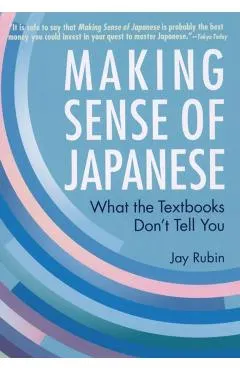
Making Sense of Japanese: What the Textbooks Don't Tell You
nMaking Sense of Japanese is the fruit of one foolhardy American's thirty-year struggle to learn and teach the Language of the Infinite.
Încă îl urmărimCum s-a mișcat prețul
Ce am observat noi
la minimToate cifrele de mai sus ies din ce am notat noi, în fiecare noapte. Nu le-am luat de nicăieri.
În fiecare zi luăm cel mai mic preț dintre toate magazinele și îl punem pe grafic. Linia verde e cel mai jos a coborât în ultima lună.
Lasă-ne adresa și îți scriem dacă scade sub —. Un singur e-mail, când chiar se întâmplă ceva. Îți cerem întâi o confirmare, și te poți retrage oricând dintr-un click.
Ce zice magazinul despre el
nMaking Sense of Japanese is the fruit of one foolhardy American's thirty-year struggle to learn and teach the Language of the Infinite. Previously known as Gone Fishin', this book has brought Jay Rubin more feedback than any of his literary translations or scholarly tomes, even if, he says, you discount the hate mail from spin-casters and the stray gill-netter. To convey his conviction that the Japanese language is not vague, Rubin has dared to explain how some of the most challenging Japanese grammatical forms work in terms of everyday English. Reached recently at a recuperative center in the hills north of Kyoto, Rubin declared, I'm still pretty sure that Japanese is not vague. Or at least, it's not as vague as it used to be. Probably. The notorious subjectless sentence of Japanese comes under close scrutiny in Part One. A sentence can't be a sentence without a subject, so even in cases where the subject seems to be lost or hiding, the author provides the tools to help you find it. Some attention is paid as well to the rest of the sentence, known technically to grammarians as the rest of the sentence. Part Two tackles a number of expressions that have baffled students of Japanese over the decades, and concludes with Rubin's patented technique of analyzing upside-down Japanese sentences right-side up, which, he claims, is far more restful than the traditional way, inside-out. The scholar, according to the great Japanese novelist Soseki Natsume, is one who specializes in making the comprehensible incomprehensible. Despite his best scholarly efforts, Rubin seems to have done just the opposite. Previously published in the Power Japanese series under the same title and originally as Gone Fishin' in the same series. nMaking Sense of Japanese is the fruit of one foolhardy American's thirty-year struggle to learn and teach the Language of the Infinite. Previously known as Gone Fishin', this book has brought Jay Rubin more feedback than any of his literary translations or scholarly tomes, even if, he says, you discount the hate mail from spin-casters and the stray gill-netter. To convey his conviction that the Japanese language is not vague, Rubin has dared to explain how some of the most challenging Japanese grammatical forms work in terms of everyday English. Reached recently at a recuperative center in the hills north of Kyoto, Rubin declared, I'm still pretty sure that Japanese is not vague. Or at least, it's not as vague as it
Descrierea e luată de la Libris.
Produse similare din Cărți în limbi străine
Vezi categoria →