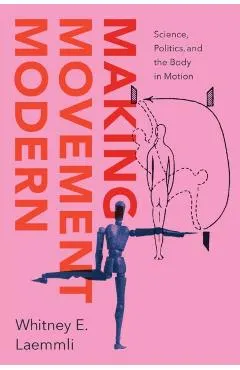
Making Movement Modern: Science, Politics, and the Body in Motion
Explores how researchers used systems for recording human movement to navigate the relationship between mind and body, freedom and control, and the individual and the state.
A fost și mai ieftin — l-am prins la 215,04 leiCum s-a mișcat prețul
Ce am observat noi
peste minimToate cifrele de mai sus ies din ce am notat noi, în fiecare noapte. Nu le-am luat de nicăieri.
În fiecare zi luăm cel mai mic preț dintre toate magazinele și îl punem pe grafic. Linia verde e cel mai jos a coborât în ultima lună.
Lasă-ne adresa și îți scriem dacă scade sub —. Un singur e-mail, când chiar se întâmplă ceva. Îți cerem întâi o confirmare, și te poți retrage oricând dintr-un click.
Ce zice magazinul despre el
Explores how researchers used systems for recording human movement to navigate the relationship between mind and body, freedom and control, and the individual and the state. n In the early twentieth century, human bodily movement garnered interest among researchers who were convinced that understanding and controlling it could help govern an increasingly frazzled, fragmented world. Making Movement Modern traces one movement visualization technique, Labanotation, from its origins in expressionist dance, Austro-Hungarian military discipline, and contemporary physiology to its employment in factories and offices a half-century later. Frustrated by societies that seemed plagued by regimentation and alienation, the users of Laban-inspired systems--from artists and scientists to factory owners, politicians, lawyers, anthropologists, psychiatrists, and computer scientists--hoped to provide opportunities for individual expression while simultaneously harnessing movement to serve the needs of larger communities, businesses, and states. n nMaking Movement Modern reveals how Labanotation's creator, choreographer Rudolf Laban, and his acolytes offered this system to a surprising variety of individuals and groups. It was a technique that promised liberation through expressive movement; it was also a means of organizing fascist displays of pure Aryan culture. The book explores these political ambiguities as Laban-based systems entered postwar society in the United States and the United Kingdom, where they were used to document disappearing folk cultures, treat Holocaust survivors, and make even the dullest, most repetitive work feel spiritually meaningful. Central to these efforts were vast programs to collect and store new kinds of personal movement data, and this history also has much to tell us about mass data collection today. This is a book for anyone interested in the relationship between art, science, data, and the human body across the tumultuous twentieth century.n
Descrierea e luată de la Libris.
Produse similare din Artă & cultură
Vezi categoria →