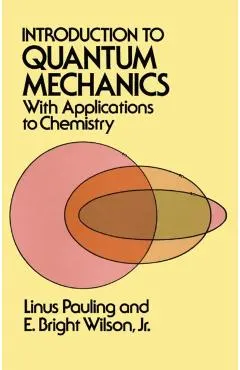
Introduction to Quantum Mechanics with Applications to Chemistry
n nWhen this classic text was first published in 1935, it fulfilled the goal of its authors to produce a textbook of practical quantum mechanics for the chemist, the experimental physicist, and the beginning…
A fost și mai ieftin — l-am prins la 97,86 leiCum s-a mișcat prețul
Ce am observat noi
peste minimToate cifrele de mai sus ies din ce am notat noi, în fiecare noapte. Nu le-am luat de nicăieri.
În fiecare zi luăm cel mai mic preț dintre toate magazinele și îl punem pe grafic. Linia verde e cel mai jos a coborât în ultima lună.
Lasă-ne adresa și îți scriem dacă scade sub —. Un singur e-mail, când chiar se întâmplă ceva. Îți cerem întâi o confirmare, și te poți retrage oricând dintr-un click.
Ce zice magazinul despre el
n nWhen this classic text was first published in 1935, it fulfilled the goal of its authors to produce a textbook of practical quantum mechanics for the chemist, the experimental physicist, and the beginning student of theoretical physics. Although many who are teachers today once worked with the book as students, the text is still as valuable for the same undergraduate audience. nTwo-time Nobel Prize winner Linus Pauling, Research Professor at the Linus Pauling Institute of Science and Medicine, Palo Alto, California, and E. Bright Wilson, Jr., Professor Emeritus of Chemistry at Harvard University, provide a readily understandable study of wave mechanics, discussing the Schrodinger wave equation and the problems which can be solved with it. Extensive knowledge of mathematics is not required, although the student must have a grasp of elementary mathematics through the calculus. Pauling and Wilson begin with a survey of classical mechanics, including Newton's equations of motion in the Lagrangian form, and then move on to the old quantum theory, developed through the work of Planck, Einstein and Bohr. This analysis leads to the heart of the book ― an explanation of quantum mechanics which, as Schrodinger formulated it, involves the renunciation of the hope of describing in exact detail the behavior of a system. Physics had created a new realm in which classical, Newtonian certainties were replaced by probabilities ― a change which Heisenberg's uncertainty principle (described in this book) subsequently reinforced. nWith clarity and precision, the authors guide the student from topic to topic, covering such subjects as the wave functions for the hydrogen atom, perturbation theory, the Pauli exclusion principle, the structure of simple and complex molecules, Van der Waals forces, and systems in thermodynamic equilibrium. To insure that the student can follow the mathematical derivations, Pauling and Wilson avoid the temptation to condense the various discussions into shorter and perhaps more elegant forms appropriate for a more advanced audience. Introduction to Quantum Mechanics is a perfect vehicle for demonstrating the practical application of quantum mechanics to a broad spectrum of chemical and physical problems.n
Descrierea e luată de la Libris.
Produse similare din Științe & tehnică
Vezi categoria →