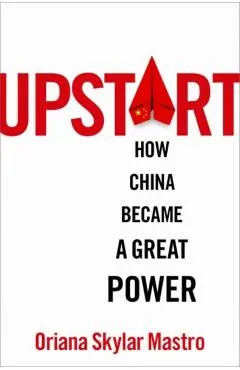
Upstart: How China Became a Great Power
A powerful new explanation of China's rise that draws from the business world to show that China is not simply copying established great powers, but exploiting geopolitical opportunities around the world that…
Încă îl urmărimCum s-a mișcat prețul
Ce am observat noi
la minimToate cifrele de mai sus ies din ce am notat noi, în fiecare noapte. Nu le-am luat de nicăieri.
În fiecare zi luăm cel mai mic preț dintre toate magazinele și îl punem pe grafic. Linia verde e cel mai jos a coborât în ultima lună.
Lasă-ne adresa și îți scriem dacă scade sub —. Un singur e-mail, când chiar se întâmplă ceva. Îți cerem întâi o confirmare, și te poți retrage oricând dintr-un click.
Ce zice magazinul despre el
A powerful new explanation of China's rise that draws from the business world to show that China is not simply copying established great powers, but exploiting geopolitical opportunities around the world that those other powers had ignored. nThirty years ago, the idea that China could challenge the United States economically, globally, and militarily seemed unfathomable. Yet today, China is considered another great power in the international system. How did China manage to build power, from a weaker resource position, in an international system that was dominated by the U.S.? What factors determined the strategies Beijing pursued to achieve this feat? n nUsing granular data and authoritative Chinese sources, Oriana Skylar Mastro demonstrates that China was able to climb to great power status through a careful mix of strategic emulation, exploitation, and entrepreneurship on the international stage. This upstart approach -- determined by where and how China chose to compete -- allowed China to rise economically, politically, and militarily, without triggering a catastrophic international backlash that would stem its rise. China emulated (i.e. pursued similar strategies to the U.S. in similar areas) when its leaders thought doing so would build power, while reassuring the U.S. of its intentions. China exploited (i.e. adopted similar approaches to the U.S. in new areas of competition) when China felt that the overall U.S. strategy was effective, but didn't want to risk direct confrontation. Lastly, China pursued entrepreneurial actions (i.e. innovative approaches to new and existing areas of competition) when it believed emulation might elicit a negative reaction and a more effective approach was available. Beyond explaining the unique nature of China's rise, Upstart: How China Became a Great Power provides policy guidance on how the U.S. can maintain a competitive edge in this new era of great power competition.n
Descrierea e luată de la Libris.
Produse similare din Istorie & societate
Vezi categoria →