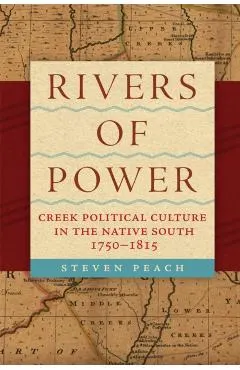
Rivers of Power: Creek Political Culture in the Native South, 1750-1815
Although the Creeks constitute a sovereign nation today, the concept of the nation meant little to their ancestors in the Native South.
Încă îl urmărimCum s-a mișcat prețul
Ce am observat noi
la minimToate cifrele de mai sus ies din ce am notat noi, în fiecare noapte. Nu le-am luat de nicăieri.
În fiecare zi luăm cel mai mic preț dintre toate magazinele și îl punem pe grafic. Linia verde e cel mai jos a coborât în ultima lună.
Lasă-ne adresa și îți scriem dacă scade sub —. Un singur e-mail, când chiar se întâmplă ceva. Îți cerem întâi o confirmare, și te poți retrage oricând dintr-un click.
Ce zice magazinul despre el
Although the Creeks constitute a sovereign nation today, the concept of the nation meant little to their ancestors in the Native South. Rather, as Steven Peach contends in Rivers of Power, the Creeks of present-day Georgia and Alabama conceptualized rivers as the basis of power, leadership, and governance in early America. n An original work of Indigenous ethnohistory, Peach's book explores the implications of this river-oriented approach to power, in which rivers were a metaphor for the subregional provinces that defined the political textures of Creek country. The provinces nurtured leaders who worked to mitigate dangers across the Native South, including intertribal war, trade dependence, settler intrusion, and land erosion. Rivers of Power describes a system in which these headmen forged remarkably malleable coalitions within and across provinces to safeguard Creek country from harm--but were in turn directed, approved, and contested by local townspeople and kin groups. Taking a unique bottom-up approach to the study of Native Americans, Peach reveals how local actors guided and thwarted Indigenous headmen far more frequently and creatively than has been assumed. He also shows that although the Creeks traced descent through the maternal line, some became more comfortable with bilateral kinship, giving weight to both the paternal and maternal lineages. Fathers and sons thus played greater roles in Creek governance than Indigenous scholarship has acknowledged. n n Weaving a new narrative of the Creeks and outlining the contours of their riverine mode of governance, this work unpacks the fraught dimensions of political power in the Native South--and, indeed, Native North America--in the eighteenth and early nineteenth centuries. By privileging Indigenous thought and intertribal history, it also advances the larger project of Native American history. nn
Descrierea e luată de la Libris.
Produse similare din Istorie & societate
Vezi categoria →