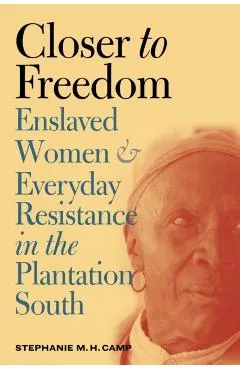
Closer to Freedom: Enslaved Women and Everyday Resistance in the Plantation South
Focusing on female slaves' everyday forms of resistanceQsuch as truancy, theft, and illegal partiesQCamp argues that the Civil War years saw a revolutionary change that had been in the making for decades, as…
Încă îl urmărimCum s-a mișcat prețul
Ce am observat noi
la minimToate cifrele de mai sus ies din ce am notat noi, în fiecare noapte. Nu le-am luat de nicăieri.
În fiecare zi luăm cel mai mic preț dintre toate magazinele și îl punem pe grafic. Linia verde e cel mai jos a coborât în ultima lună.
Lasă-ne adresa și îți scriem dacă scade sub —. Un singur e-mail, când chiar se întâmplă ceva. Îți cerem întâi o confirmare, și te poți retrage oricând dintr-un click.
Ce zice magazinul despre el
Focusing on female slaves' everyday forms of resistanceQsuch as truancy, theft, and illegal partiesQCamp argues that the Civil War years saw a revolutionary change that had been in the making for decades, as slaves broke rules, spoke their minds, and ran away. nRecent scholarship on slavery has explored the lives of enslaved people beyond the watchful eye of their masters. Building on this work and the study of space, social relations, gender, and power in the Old South, Stephanie Camp examines the everyday containment and movement of enslaved men and, especially, enslaved women. In her investigation of the movement of bodies, objects, and information, Camp extends our recognition of slave resistance into new arenas and reveals an important and hidden culture of opposition. n nCamp discusses the multiple dimensions to acts of resistance that might otherwise appear to be little more than fits of temper. She brings new depth to our understanding of the lives of enslaved women, whose bodies and homes were inevitably political arenas. Through Camp's insight, truancy becomes an act of pursuing personal privacy. Illegal parties (frolics) become an expression of bodily freedom. And bondwomen who acquired printed abolitionist materials and posted them on the walls of their slave cabins (even if they could not read them) become the subtle agitators who inspire more overt acts. n nThe culture of opposition created by enslaved women's acts of everyday resistance helped foment and sustain the more visible resistance of men in their individual acts of running away and in the collective action of slave revolts. Ultimately, Camp argues, the Civil War years saw revolutionary change that had been in the making for decades. nn
Descrierea e luată de la Libris.
Produse similare din Istorie & societate
Vezi categoria →