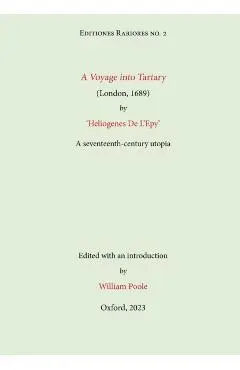
A Voyage into Tartary (London, 1689) by Heliogenes De L'Epy: A seventeenth-century Utopia
n nA Voyage into Tartary (London, 1689), by a writer calling himself 'Heliogenes De L'Epy', is a hitherto unedited seventeenth-century utopia, purportedly written by a French traveller, but in all likelihood…
Încă îl urmărimCum s-a mișcat prețul
Ce am observat noi
la minimToate cifrele de mai sus ies din ce am notat noi, în fiecare noapte. Nu le-am luat de nicăieri.
În fiecare zi luăm cel mai mic preț dintre toate magazinele și îl punem pe grafic. Linia verde e cel mai jos a coborât în ultima lună.
Lasă-ne adresa și îți scriem dacă scade sub —. Un singur e-mail, când chiar se întâmplă ceva. Îți cerem întâi o confirmare, și te poți retrage oricând dintr-un click.
Ce zice magazinul despre el
n nA Voyage into Tartary (London, 1689), by a writer calling himself 'Heliogenes De L'Epy', is a hitherto unedited seventeenth-century utopia, purportedly written by a French traveller, but in all likelihood the work of a hidden English author. The text has often been mistaken over the centuries as a genuine piece of travel writing, but in reality A Voyage into Tartary is fictional throughout, and its latter half consists of a utopia of unusually radical parameters. n n nn nHeliogenes recounts how he travelled far into the lands of 'Tartary' (a region chiefly overlapping with the modern Russian and Chinese lands), where he encounters an isolated but advanced civilisation living in communism and worshipping the Sun. These 'Heliopolitans' are the descendants of Greek philosophers who travelled east in the aftermath of the death of Alexander the Great, and who preserve to this day the ancient Greek language. These Sun-worshipping philosophers, however, turn out to be borderline atheists, paying homage to the Sun merely as the most powerful visible material thing, but who admit neither a Creator God in the manner of monotheistic, providential religions, nor indeed any higher non-material principle at all. They regard Christianity, when it is explained to them by Heliogenes, as obviously spurious, shelving Heliogenes' copy of the New Testament among the books of 'mythology' in their state library. As Heliogenes complains, 'All the while that I convers'd with them, I could not find that they had any Notion of God after our manner.' n n nn nA Voyage into Tartary is a remarkable and almost unknown text of the period, influenced by recent writing in both English and French, including Frenchn nutopian texts such as Denis Veiras's The History of the Sevarites (1675-) and Gabriel de Foigny's La Terre Australe connue (1676). But its achievement is distinctive, as are its opening sections of pseudo-travel in Greek, Turkish, and Persian lands. It deserves to be more widely known, and to that end this editio princeps provides a fully annotated text of the only edition, prefaced by a substantial critical and textual introduction, including a discussion of the true identity of the hidden author. n
Descrierea e luată de la Libris.
Produse similare din Ficțiune & literatură
Vezi categoria →