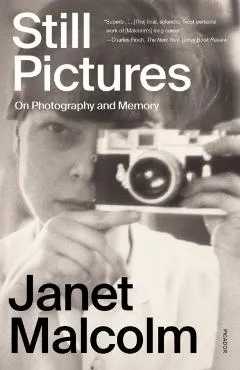
Still Pictures: On Photography and Memory
nSuperb . . . [The] final, splendid, most personal work of [Janet Malcolm's] long career.
A fost și mai ieftin — l-am prins la 103,68 leiCum s-a mișcat prețul
Ce am observat noi
peste minimToate cifrele de mai sus ies din ce am notat noi, în fiecare noapte. Nu le-am luat de nicăieri.
În fiecare zi luăm cel mai mic preț dintre toate magazinele și îl punem pe grafic. Linia verde e cel mai jos a coborât în ultima lună.
Lasă-ne adresa și îți scriem dacă scade sub —. Un singur e-mail, când chiar se întâmplă ceva. Îți cerem întâi o confirmare, și te poți retrage oricând dintr-un click.
Ce zice magazinul despre el
nSuperb . . . [The] final, splendid, most personal work of [Janet Malcolm's] long career. --Charles Finch, The New York Times Book Review n nFor decades, Janet Malcolm's books and dispatches for The New Yorker and The New York Review of Books poked and prodded at reportorial and biographical convention, gesturing toward the artifice that underpins both public and private selves. In Still Pictures, she turns her gimlet eye on her own life--a task demanding a writer just as peerlessly skillful as she was widely known to be. n nStill Pictures, then, is not the story of a life but an event on its own terms, an encounter with identity and family photographs as poignant and original as anything since Roland Barthes's Camera Lucida. Malcolm looks beyond the content of the image and the easy seductions of self-recognition, constructing a memoir from memories that pose questions of their own. n nStill Pictures begins with the image of a morose young girl on a train, leaving Prague for New York at the age of five in 1939. From her fitful early loves, to evenings at the old Metropolitan Opera House, to her fascination with what it might mean to be a bad girl, Malcolm assembles a composite portrait of a New York childhood, one that never escapes the tug of Europe and the mysteries of fate and family. Later, Still Pictures delves into her marriage to Gardner Botsford, the world of William Shawn's New Yorker, and the libel trial that led Malcolm to become a character in her own drama. n nDisplaying the sharp wit and astute commentary that are Malcolmian trademarks, this brief volume develops into a memoir like few others in our literature.n
Descrierea e luată de la Libris.
Produse similare din Biografii & memorii
Vezi categoria →