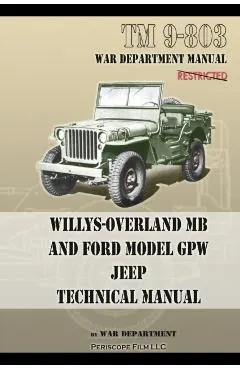
TM 9-803 Willys-Overland MB and Ford Model GPW Jeep Technical Manual
nDesignated as a light truck, the Jeep was the primary four-wheel drive vehicle for the U.S.
Încă îl urmărimCum s-a mișcat prețul
Ce am observat noi
la minimToate cifrele de mai sus ies din ce am notat noi, în fiecare noapte. Nu le-am luat de nicăieri.
În fiecare zi luăm cel mai mic preț dintre toate magazinele și îl punem pe grafic. Linia verde e cel mai jos a coborât în ultima lună.
Lasă-ne adresa și îți scriem dacă scade sub —. Un singur e-mail, când chiar se întâmplă ceva. Îți cerem întâi o confirmare, și te poți retrage oricând dintr-un click.
Ce zice magazinul despre el
nDesignated as a light truck, the Jeep was the primary four-wheel drive vehicle for the U.S. Army during WWII. The Jeep's design owed a great deal to Karl Probst, a freelance designer employed by the American Bantam Car Co. Probst's prototype Blitz Buggy was built in a mere 49 days. It clearly impressed the Army in head-to-head competition against a design submitted by Willys-Overland. However the Buggy's engine failed to meet requirements, and the Army determined that Bantam could not produce the vehicle in quantity. As a result, the Army bought the Bantam design and asked both Willys and Ford to improve it. The Willys model MB, equipped with a L134 straight-4 Go Devilengine, was eventually accepted as the standard. Ford models built to Willys specifications were designated GPW (G for government vehicle, P designating the 80 wheelbase, and W indicating the Willys engine design). (Notably, the GP part of the designation is often misinterpreted to mean General Purpose, and some have suggested this is the reason the vehicle wasnick-named the Jeep. In reality it was probably named after a character in the Popeye cartoons). Roughly 640,000 Jeeps were built during WWII by Ford and Willys, and used on every front. Utilitarian, rugged, and easy to maintain, Jeeps saw service as scout cars, ambulances, firefighting vehicles, as tractors for artillery, and more. The vehicle so impressed war correspondent Ernie Pyle that he called it one of the two most important pieces of non-combat equipment ever developed - the other being the pocket stove. Jeeps remained in service for the U.S. military in Korea and in the Vietnam War. Created in 1944, this technical manual reveals a great deal about the Jeep's design and capabilities. Intended as a manual for those charged with operation and maintenance, this manual shows many aspects of its engine, cooling, power, drive train and other systems. Originally labeled restricted, this manual was declassified long ago and is here reprinted in book form. Care has been taken to preserve the integrity of the text.
Descrierea e luată de la Libris.
Produse similare din Istorie & societate
Vezi categoria →