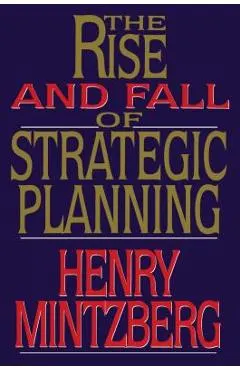
Rise and Fall of Strategic Planning
nIn this definitive and revealing history, Henry Mintzberg, the iconoclastic former president of the Strategic Management Society, unmasks the press that has mesmerized so many organizations since 1965:…
Încă îl urmărimCum s-a mișcat prețul
Ce am observat noi
la minimToate cifrele de mai sus ies din ce am notat noi, în fiecare noapte. Nu le-am luat de nicăieri.
În fiecare zi luăm cel mai mic preț dintre toate magazinele și îl punem pe grafic. Linia verde e cel mai jos a coborât în ultima lună.
Lasă-ne adresa și îți scriem dacă scade sub —. Un singur e-mail, când chiar se întâmplă ceva. Îți cerem întâi o confirmare, și te poți retrage oricând dintr-un click.
Ce zice magazinul despre el
nIn this definitive and revealing history, Henry Mintzberg, the iconoclastic former president of the Strategic Management Society, unmasks the press that has mesmerized so many organizations since 1965: strategic planning. One of our most brilliant and original management thinkers, Mintzberg concludes that the term is an oxymoron -- that strategy cannot be planned because planning is about analysis and strategy is about synthesis. That is why, he asserts, the process has failed so often and so dramatically. n Mintzberg traces the origins and history of strategic planning through its prominence and subsequent fall. He argues that we must reconceive the process by which strategies are created -- by emphasizing informal learning and personal vision -- and the roles that can be played by planners. Mintzberg proposes new and unusual definitions of planning and strategy, and examines in novel and insightful ways the various models of strategic planning and the evidence of why they failed. Reviewing the so-called pitfalls of planning, he shows how the process itself can destroy commitment, narrow a company's vision, discourage change, and breed an atmosphere of politics. In a harsh critique of many sacred cows, he describes three basic fallacies of the process -- that discontinuities can be predicted, that strategists can be detached from the operations of the organization, and that the process of strategy-making itself can be formalized. n Mintzberg devotes a substantial section to the new role for planning, plans, and planners, not inside the strategy-making process, but in support of it, providing some of its inputs and sometimes programming its outputs as well as encouraging strategic thinking in general. This book is required reading for anyone in an organization who is influenced by the planning or the strategy-making processes.
Descrierea e luată de la Libris.
Produse similare din Business & economie
Vezi categoria →