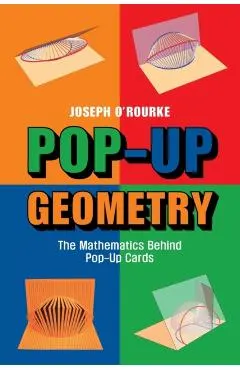
Pop-Up Geometry: The Mathematics Behind Pop-Up Cards
nAnyone browsing at the stationery store will see an incredible array of pop-up cards available for any occasion.
A fost și mai ieftin — l-am prins la 210,80 leiCum s-a mișcat prețul
Ce am observat noi
peste minimToate cifrele de mai sus ies din ce am notat noi, în fiecare noapte. Nu le-am luat de nicăieri.
În fiecare zi luăm cel mai mic preț dintre toate magazinele și îl punem pe grafic. Linia verde e cel mai jos a coborât în ultima lună.
Lasă-ne adresa și îți scriem dacă scade sub —. Un singur e-mail, când chiar se întâmplă ceva. Îți cerem întâi o confirmare, și te poți retrage oricând dintr-un click.
Ce zice magazinul despre el
nAnyone browsing at the stationery store will see an incredible array of pop-up cards available for any occasion. The workings of pop-up cards and pop-up books can be remarkably intricate. Behind such designs lies beautiful geometry involving the intersection of circles, cones, and spheres, the movements of linkages, and other constructions. The geometry can be modelled by algebraic equations, whose solutions explain the dynamics. For example, several pop-up motions rely on the intersection of three spheres, a computation made every second for GPS location. Connecting the motions of the card structures with the algebra and geometry reveals abstract mathematics performing tangible calculations. Beginning with the nephroid in the 19th-century, the mathematics of pop-up design is now at the frontiers of rigid origami and algorithmic computational complexity. All topics are accessible to those familiar with high-school mathematics; no calculus required. Explanations are supplemented by 140+ figures and 20 animations.
Descrierea e luată de la Libris.
Produse similare din Științe & tehnică
Vezi categoria →