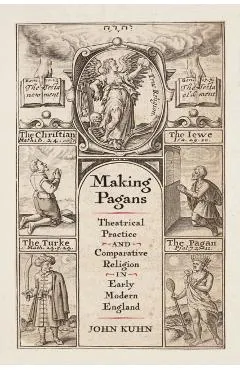
Making Pagans: Theatrical Practice and Comparative Religion in Early Modern England
nHow early modern theatrical practice helped construct the category of pagan as a tool of European self-definition and colonial ambition n nIn Making Pagans, John Kuhn argues that drama played a powerful role i
A fost și mai ieftin — l-am prins la 386,46 leiCum s-a mișcat prețul
Ce am observat noi
peste minimToate cifrele de mai sus ies din ce am notat noi, în fiecare noapte. Nu le-am luat de nicăieri.
În fiecare zi luăm cel mai mic preț dintre toate magazinele și îl punem pe grafic. Linia verde e cel mai jos a coborât în ultima lună.
Lasă-ne adresa și îți scriem dacă scade sub —. Un singur e-mail, când chiar se întâmplă ceva. Îți cerem întâi o confirmare, și te poți retrage oricând dintr-un click.
Ce zice magazinul despre el
nHow early modern theatrical practice helped construct the category of pagan as a tool of European self-definition and colonial ambition n nIn Making Pagans, John Kuhn argues that drama played a powerful role in the articulation of religious difference in the seventeenth century. Tracing connections between the history of stagecraft and ethnological disciplines such as ethnography, antiquarianism, and early comparative religious writing, Kuhn shows how early modern repertory systems that leaned heavily on thrift and reuse produced an enduring theatrical vocabulary for understanding religious difference through the representation of paganism--a key term in the new taxonomy of world religions emerging at this time, and a frequent subject and motif in English drama of the era. n nCombining properties such as triumphal chariots, trick alters, and moving statues with music, special effects, and other elements, the spectacular set-pieces that were mostly developed for plays set in antiquity, depicting England's pre-Christian past, were frequently repurposed in new plays, in representations of Native Americans and Africans in colonial contact zones. Kuhn argues that the recycling of these set-pieces encouraged audiences to process new cultural sites through the lens of old performance tropes, and helped produce fictitious, quasi-ethnographic knowledge for spectators, generating the idea of a homogeneous, trans-historical, trans-geographical paganism. Examining the common scenes of pagan ritual that filled England's seventeenth-century stages--magical conjurations, oracular prophecies, barbaric triumphal parades, and group suicides--Kuhn traces these tropes across dozens of plays, from a range of authors including Ben Jonson, Christopher Marlowe, John Dryden, and Philip Massinger. n nDrawing together theater history, Atlantic studies, and the history of comparative religion, Making Pagans reconceptualizes the material and iterative practices of the theater as central to the construction of radical religious difference in early modernity and of the category of paganism as a tool of European self-definition and colonial ambition.n
Descrierea e luată de la Libris.
Produse similare din Religie & spiritualitate
Vezi categoria →