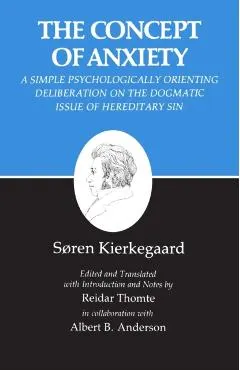
Kierkegaard's Writings, VIII, Volume 8: Concept of Anxiety: A Simple Psychologically Orienting Deliberation on the Dogmatic Issue of Hereditary Sin
nThis edition replaces the earlier translation by Walter Lowrie that appeared under the title The Concept of Dread.
Încă îl urmărimCum s-a mișcat prețul
Ce am observat noi
la minimToate cifrele de mai sus ies din ce am notat noi, în fiecare noapte. Nu le-am luat de nicăieri.
În fiecare zi luăm cel mai mic preț dintre toate magazinele și îl punem pe grafic. Linia verde e cel mai jos a coborât în ultima lună.
Lasă-ne adresa și îți scriem dacă scade sub —. Un singur e-mail, când chiar se întâmplă ceva. Îți cerem întâi o confirmare, și te poți retrage oricând dintr-un click.
Ce zice magazinul despre el
nThis edition replaces the earlier translation by Walter Lowrie that appeared under the title The Concept of Dread. Along with The Sickness unto Death, the work reflects from a psychological point of view S ren Kierkegaard's longstanding concern with the Socratic maxim, Know yourself. His ontological view of the self as a synthesis of body, soul, and spirit has influenced philosophers such as Heidegger and Sartre, theologians such as Jaspers and Tillich, and psychologists such as Rollo May. In The Concept of Anxiety, Kierkegaard describes the nature and forms of anxiety, placing the domain of anxiety within the mental-emotional states of human existence that precede the qualitative leap of faith to the spiritual state of Christianity. It is through anxiety that the self becomes aware of its dialectical relation between the finite and the infinite, the temporal and the eternal. nThis edition replaces the earlier translation by Walter Lowrie that appeared under the title The Concept of Dread. Along with The Sickness unto Death, the work reflects from a psychological point of view S ren Kierkegaard's longstanding concern with the Socratic maxim, Know yourself. His ontological view of the self as a synthesis of body, soul, and spirit has influenced philosophers such as Heidegger and Sartre, theologians such as Jaspers and Tillich, and psychologists such as Rollo May. n In The Concept of Anxiety, Kierkegaard describes the nature and forms of anxiety, placing the domain of anxiety within the mental-emotional states of human existence that precede the qualitative leap of faith to the spiritual state of Christianity. It is through anxiety that the self becomes aware of its dialectical relation between the finite and the infinite, the temporal and the eternal. nThis edition replaces the earlier translation by Walter Lowrie that appeared under the title The Concept of Dread. Along with The Sickness unto Death, the work reflects from a psychological point of view S ren Kierkegaard's longstanding concern with the Socratic maxim, Know yourself. His ontological view of the self as a synthesis of body, soul, and spirit has influenced philosophers such as Heidegger and Sartre, theologians such as Jaspers and Tillich, and psychologists such as Rollo May. n In The Concept of Anxiety, Kierkegaard describes the nature and forms of anxiety, placing the domain of anxiety within the mental-emotional states of human existence that precede the qualitative leap of fai
Descrierea e luată de la Libris.
Alte cărți de Soren Kierkegaard

Produse similare din Psihologie & filosofie
Vezi categoria →