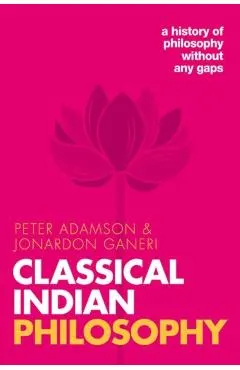
Classical Indian Philosophy: A History of Philosophy Without Any Gaps, Volume 5
nPeter Adamson and Jonardon Ganeri present a lively introduction to one of the world's richest intellectual traditions: the philosophy of classical India.
A fost și mai ieftin — l-am prins la 141,20 leiCum s-a mișcat prețul
Ce am observat noi
peste minimToate cifrele de mai sus ies din ce am notat noi, în fiecare noapte. Nu le-am luat de nicăieri.
În fiecare zi luăm cel mai mic preț dintre toate magazinele și îl punem pe grafic. Linia verde e cel mai jos a coborât în ultima lună.
Lasă-ne adresa și îți scriem dacă scade sub —. Un singur e-mail, când chiar se întâmplă ceva. Îți cerem întâi o confirmare, și te poți retrage oricând dintr-un click.
Ce zice magazinul despre el
nPeter Adamson and Jonardon Ganeri present a lively introduction to one of the world's richest intellectual traditions: the philosophy of classical India. They begin with the earliest extant literature, the Vedas, and the explanatory works that these inspired, known as Upaniṣads. They also ndiscuss other famous texts of classical Vedic culture, especially the Mahābhārata and its most notable section, the Bhagavad-Gīta, alongside the rise of Buddhism and Jainism. In this opening section, Adamson and Ganeri emphasize the way that philosophy was practiced as a form of life in search of nliberation from suffering. nNext, the pair move on to the explosion of philosophical speculation devoted to foundational texts called 'sutras, ' discussing such traditions as the logical and epistemological Nyd=aya school, the monism of Advaita Vedānta, and the spiritual discipline of Yoga. n nIn the final section of the book, they chart further developments within Buddhism, highlighting Nagārjuna's radical critique of 'non-dependent' concepts and the no-self philosophy of mind found in authors like Dignāga, and within Jainism, focusing especially on its 'standpoint' epistemology. Unlike nother introductions that cover the main schools and positions in classical Indian philosophy, Adamson and Ganeri's lively guide also pays attention to philosophical themes such as non-violence, political authority, and the status of women, while considering textual traditions typically left out of noverviews of Indian thought, like the Cārvāka school, Tantra, and aesthetic theory as well. n nAdamson and Ganeri conclude by focusing on the much-debated question of whether Indian philosophy may have influenced ancient Greek philosophy and, from there, evaluate the impact that this area of philosophy had on later Western thought. nn
Descrierea e luată de la Libris.
Alte cărți de Peter Adamson

Produse similare din Psihologie & filosofie
Vezi categoria →