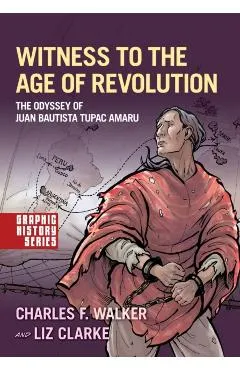
Witness to the Age of Revolution: The Odyssey of Juan Bautista Tupac Amaru
nThe Tupac Amaru rebellion of 1780-1783 began as a local revolt against colonial authorities and grew into the largest rebellion in the history of Spain's American empire-more widespread and deadlier than the…
Încă îl urmărimCum s-a mișcat prețul
Ce am observat noi
la minimToate cifrele de mai sus ies din ce am notat noi, în fiecare noapte. Nu le-am luat de nicăieri.
În fiecare zi luăm cel mai mic preț dintre toate magazinele și îl punem pe grafic. Linia verde e cel mai jos a coborât în ultima lună.
Lasă-ne adresa și îți scriem dacă scade sub —. Un singur e-mail, când chiar se întâmplă ceva. Îți cerem întâi o confirmare, și te poți retrage oricând dintr-un click.
Ce zice magazinul despre el
nThe Tupac Amaru rebellion of 1780-1783 began as a local revolt against colonial authorities and grew into the largest rebellion in the history of Spain's American empire-more widespread and deadlier than the American Revolution. An official collector of tribute for the imperial crown, Jos� Gabriel Condorcanqui had seen firsthand what oppressive Spanish rule meant for Peru's Indian population and, under the Inca royal name Tupac Amaru, he set events in motion that would transform him into one of Latin America's most iconic revolutionary figures. While he and the rebellion's leaders were put to death, his half-brother, Juan Bautista Tupac Amaru, survived but paid a high price for his participation in the uprising. This work in the Graphic History series is based on the memoir written by Juan Bautista about his odyssey as a prisoner of Spain. He endured forty years in jails, dungeons, and presidios on both sides of the Atlantic. Juan Bautista spent two years in jail in Cusco, was freed, rearrested, and then marched 700 miles in chains over the Andes to Lima. He spent two years aboard a ship travelling around Cape Horn to Spain. Subsequently, he endured over thirty years imprisoned in Ceuta, Spain's much-feared garrison city on the northern tip of Africa. In 1822, priest Marcos Dur�n Martel and Maltese-Argentine naval hero Juan Bautista Azopardo arranged to have him freed and sent to the newly independent Argentina, where he became a symbol of Argentina's short-lived romance with the Incan Empire. There he penned his memoirs, but died without fulfilling his dream of returning to Peru. This stunning graphic history relates the life and legacy of Juan Bautista Tupac Amaru, enhanced by a selection of primary sources, and chronicles the harrowing and extraordinary life of a firsthand witness to the Age of Revolution. n. n nThe Tupac Amaru rebellion of 1780-1783 began as a local revolt against colonial authorities and grew into the largest rebellion in the history of Spain's American empire-more widespread and deadlier than the American Revolution. An official collector of tribute for the imperial crown, Jos� Gabriel Condorcanqui had seen firsthand what oppressive Spanish rule meant for Peru's Indian population and, under the Inca royal name Tupac Amaru, he set events in motion that would transform him into one of Latin America's most iconic revolutionary figures. While he and the rebellion's leaders were put to death, his half-broth
Descrierea e luată de la Libris.
Produse similare din Biografii & memorii
Vezi categoria →