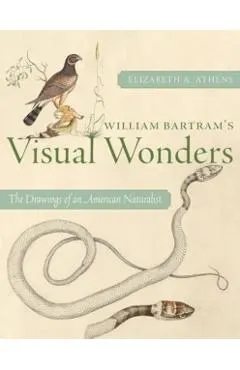
William Bartram's Visual Wonders: The Drawings of an American Naturalist
Pennsylvania naturalist William Bartram (1739-1823) is best known as the author of a travelogue describing his botanizing journey through the American South in the late eighteenth century.
Încă îl urmărimCum s-a mișcat prețul
Ce am observat noi
la minimToate cifrele de mai sus ies din ce am notat noi, în fiecare noapte. Nu le-am luat de nicăieri.
În fiecare zi luăm cel mai mic preț dintre toate magazinele și îl punem pe grafic. Linia verde e cel mai jos a coborât în ultima lună.
Lasă-ne adresa și îți scriem dacă scade sub —. Un singur e-mail, când chiar se întâmplă ceva. Îți cerem întâi o confirmare, și te poți retrage oricând dintr-un click.
Ce zice magazinul despre el
Pennsylvania naturalist William Bartram (1739-1823) is best known as the author of a travelogue describing his botanizing journey through the American South in the late eighteenth century. Writing was not, however, Bartram's only or even preferred method of recording the natural world around him. His deeply unconventional drawings, depicting sentient plants and hybrid organic forms, lie at the heart of his understanding of nature. With this book, Elizabeth Athens considers the strangeness of Bartram's graphic enterprise, exploring the essential role his renderings played in his natural history. For Bartram, the making and interpretation of figures on a surface was a dynamic and collaborative relationship between nature, the observing artist-naturalist, and the audience. This book offers the first in-depth investigation of Bartram's drawing practice as central to his understanding of nature. Through an examination of Bartram's approach to botanical and zoological representation, Athens highlights the struggle between different modes of seeing nature in eighteenth-century Enlightenment science. nFinalist, The Athenaeum of Philadelphia 2025 Literary Award Pennsylvania naturalist William Bartram (1739-1823) is best known as the author of a travelogue describing his botanizing journey through the American South in the late eighteenth century. Writing was not, however, Bartram's only or even preferred method of recording the natural world around him. His deeply unconventional drawings, depicting sentient plants and hybrid organic forms, lie at the heart of his understanding of nature. With this book, Elizabeth Athens considers the strangeness of Bartram's graphic enterprise, exploring the essential role his renderings played in his natural history. For Bartram, the making and interpretation of figures on a surface was a dynamic and collaborative relationship between nature, the observing artist-naturalist, and the audience. This book offers the first in-depth investigation of Bartram's drawing practice as central to his understanding of nature. Through an examination of Bartram's approach to botanical and zoological representation, Athens highlights the struggle between different modes of seeing nature in eighteenth-century Enlightenment science.
Descrierea e luată de la Libris.
Produse similare din Diverse
Vezi categoria →