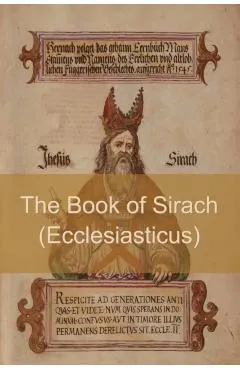
The Book of Sirach (or Ecclesiasticus)
The Book of Sirach (Ecclesiasticus; abbreviated Ecclus.) is a Jewish work, originally in Hebrew, of ethical teachings, from approximately 200 to 175 BCE, written by the Judahite scribe Ben Sira of Jerusalem, on
A fost și mai ieftin — l-am prins la 101,70 leiCum s-a mișcat prețul
Ce am observat noi
peste minimToate cifrele de mai sus ies din ce am notat noi, în fiecare noapte. Nu le-am luat de nicăieri.
În fiecare zi luăm cel mai mic preț dintre toate magazinele și îl punem pe grafic. Linia verde e cel mai jos a coborât în ultima lună.
Lasă-ne adresa și îți scriem dacă scade sub —. Un singur e-mail, când chiar se întâmplă ceva. Îți cerem întâi o confirmare, și te poți retrage oricând dintr-un click.
Ce zice magazinul despre el
The Book of Sirach (Ecclesiasticus; abbreviated Ecclus.) is a Jewish work, originally in Hebrew, of ethical teachings, from approximately 200 to 175 BCE, written by the Judahite scribe Ben Sira of Jerusalem, on the inspiration of his father Joshua son of Sirach, sometimes called Jesus son of Sirach or Yeshua ben Eliezer ben Sira. n In Egypt, it was translated into Greek by the author's unnamed grandson, who added a prologue. This prologue is generally considered the earliest witness to a canon of the books of the prophets, and thus the date of the text is the subject of intense scrutiny. The book itself is the largest wisdom book from antiquity to have survived. n Although excluded from the Jewish canon, Sirach was read and quoted as authoritative from the beginning of the rabbinic period. There are numerous citations to Sirach in the Talmud and works of rabbinic literature (as ספר בן סירא, e.g., Hagigah 13a, Niddah 16b; Ber. 11b). Some of those (Sanhedrin 100b) record an unresolved debate between R'Joseph and Abaye as to whether it is forbidden to read the book of Sirach, wherein Abaye repeatedly draws parallels between statements in Sirach cited by R'Joseph as objectionable and similar statements appearing in canonical books. n Sirach may have been used as a basis for two important parts of the Jewish liturgy. In the Mahzor (High Holiday prayer book), a medieval Jewish poet may have used Sirach as the basis for a poem, Mar'e Kohen, in the Yom Kippur musaf (additional) service for the High Holidays. Yosef Tabori questioned whether this passage in Sirach is referring at all to Yom Kippur, and thus argued it cannot form the basis of this poem. Some early 20th-century scholars also argued that the vocabulary and framework used by Sirach formed the basis of the most important of all Jewish prayers, the Amidah, but that conclusion is disputed as well. n Current scholarship takes a more conservative approach. On one hand, scholars find that Ben Sira links Torah and wisdom with prayer in a manner that calls to mind the later views of the Rabbis, and that the Jewish liturgy echoes Sirach in the use of hymns of praise, supplicatory prayers and benedictions, as well as the occurrence of [Biblical] words and phrases [that] take on special forms and meanings. However, they stop short of concluding a direct relationship existed; rather, what seems likely is that the Rabbis ultimately borrowed extensively from the kinds of circles which produced Be
Descrierea e luată de la Libris.
Alte cărți de Anonymous

Produse similare din Istorie & societate
Vezi categoria →