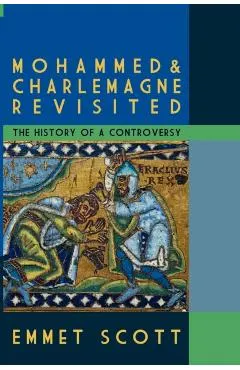
Mohammed & Charlemagne Revisited: The History of a Controversy
nDuring the 1920s Belgian historian Henri Pirenne came to an astonishing conclusion: the ancient classical civilization, which Rome had established throughout Europe and the Mediterranean world, was not destroy
Încă îl urmărimCum s-a mișcat prețul
Ce am observat noi
la minimToate cifrele de mai sus ies din ce am notat noi, în fiecare noapte. Nu le-am luat de nicăieri.
În fiecare zi luăm cel mai mic preț dintre toate magazinele și îl punem pe grafic. Linia verde e cel mai jos a coborât în ultima lună.
Lasă-ne adresa și îți scriem dacă scade sub —. Un singur e-mail, când chiar se întâmplă ceva. Îți cerem întâi o confirmare, și te poți retrage oricând dintr-un click.
Ce zice magazinul despre el
nDuring the 1920s Belgian historian Henri Pirenne came to an astonishing conclusion: the ancient classical civilization, which Rome had established throughout Europe and the Mediterranean world, was not destroyed by the Barbarians who invaded the western provinces in the fifth century, it was destroyed by the Arabs, whose conquest of the Middle East and North Africa terminated Roman civilization in those regions and cut off Europe from any further trading and cultural contact with the East. According to Pirenne, it was only in the mid-seventh century that the characteristic features of classical life disappeared from Europe, after which time the continent began to develop its own distinctive and somewhat primitive medieval culture. Pirenne's findings, published posthumously in his Mohammed et Charlemagne (1937), were even then highly controversial, for by the late nineteenth century many historians were moving towards a quite different conclusion: namely that the Arabs were actually a civilizing force who rekindled the light of classical learning in Europe after it had been extinguished by the Goths, Vandals and Huns in the fifth century. And because Pirenne went so diametrically against the grain of this thinking, the reception of his new thesis tended to be hostile. Paper after paper published during the 1940s and '50s strove to refute him. The most definitive rebuttal however appeared in the early 1980s. This was Mohammed, Charlemagne and the Origins of Europe, by English archaeologists Richard Hodges and David Whitehouse. These, in common with Pirenne's earlier critics, argued that classical civilization was already dead in Europe by the time of the Arab conquests, and that the Arabs arrived on the scene as civilizers rather than destroyers. Hodges and Whitehouse claimed that the latest findings of archaeology fully supported this view, and their work was highly influential. So influential indeed that over the next three decades Pirenne and his thesis was progressively sidelined, so that recent years have seen the publication of dozens of titles in the English language alone which fail even to mention his name. In Mohammed and Charlemagne Revisited historian Emmet Scott reviews the evidence put forward by Hodges and Whitehouse, as well as the more recent findings of archaeology, and comes to a rather different conclusion. For him, the evidence shows that classical civilization was not dead in Europe at the start of the seventh century, but was actua
Descrierea e luată de la Libris.
Produse similare din Istorie & societate
Vezi categoria →