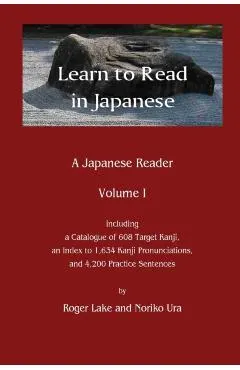
Learn to Read in Japanese: A Japanese Reader
nThe design of this Japanese Reader is based on our belief that the most enjoyable and efficient way to learn to read in Japanese is to dive in and start reading sentences almost immediately, learning new…
A fost și mai ieftin — l-am prins la 223,15 leiCum s-a mișcat prețul
Ce am observat noi
peste minimToate cifrele de mai sus ies din ce am notat noi, în fiecare noapte. Nu le-am luat de nicăieri.
În fiecare zi luăm cel mai mic preț dintre toate magazinele și îl punem pe grafic. Linia verde e cel mai jos a coborât în ultima lună.
Lasă-ne adresa și îți scriem dacă scade sub —. Un singur e-mail, când chiar se întâmplă ceva. Îți cerem întâi o confirmare, și te poți retrage oricând dintr-un click.
Ce zice magazinul despre el
nThe design of this Japanese Reader is based on our belief that the most enjoyable and efficient way to learn to read in Japanese is to dive in and start reading sentences almost immediately, learning new kanji as you go. In order to make this approach workable, we introduce about ten new kanji at the beginning of each chapter and then ask you to take a quick pre-test on their pronunciations before starting to read. We include in each chapter only kanji characters that you know or are in the process of learning, and we provide immediate feedback about your reading accuracy in the form of same-page romaji equivalents and translations. Although it might seem impractical to start reading practice before you have learned Japanese characters very well, this approach is firmly grounded in a study technique known as Active Recall, which can be defined as learning by answering questions. Active Recall is the basis of flashcard learning generally, and it is highly effective for building strong memories, compared to more passive study methods.
When you try to read one of the Japanese sentences in this book, you are essentially asking yourself two questions How is this sentence pronounced, and what does it mean? This self-interrogation forces your brain to work in order to recognize the characters in the sentence and recall their pronunciations. When you need to look at the answers to the implied questions, they are available on the same page. This means that you can significantly reduce the amount of time that you spend memorizing kanji. You can also minimize the number of times that you need to look up information in other books or dictionaries as you read.
The book includes 4,200 Japanese sentences which employ only hiragana, katakana and 608 target kanji. Romaji equivalents and translations are always available, printed in very small text in a column adjacent to the Japanese text, but they are easy to ignore when you don't need them. By simply reading and taking advantage of the feedback and the references in the book, you will soon be able to read with confidence.
The target kanji that are used in the sentences are taught by means of an innovative Kanji Catalogue. This Catalogue includes pronunciations, meanings, descriptions of the kanji as images, and examples of words that use the kanji.
When you encounter a kanji in the Japanese text that you do not know well, you can easily look it up with the help of the Pronunciation Index which contains 1,634 kanj
Descrierea e luată de la Libris.
Produse similare din Cărți în limbi străine
Vezi categoria →