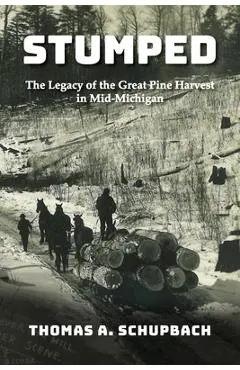
Stumped: Harvesting the Great Pine Forest in Mid-Michigan and the Cutover Legacy
nWhen Michigan joined the Union, in 1837, it acquired nearly 14 million acres of land from the 1836 treaty.
Încă îl urmărimCum s-a mișcat prețul
Ce am observat noi
la minimToate cifrele de mai sus ies din ce am notat noi, în fiecare noapte. Nu le-am luat de nicăieri.
În fiecare zi luăm cel mai mic preț dintre toate magazinele și îl punem pe grafic. Linia verde e cel mai jos a coborât în ultima lună.
Lasă-ne adresa și îți scriem dacă scade sub —. Un singur e-mail, când chiar se întâmplă ceva. Îți cerem întâi o confirmare, și te poți retrage oricând dintr-un click.
Ce zice magazinul despre el
nWhen Michigan joined the Union, in 1837, it acquired nearly 14 million acres of land from the 1836 treaty. It took several years to survey the land, at which point the complex process of land disposal began, ultimately resulting in private ownership. This occurred just in time for the lumber industry to move its focus from exhausted lands in New England to the great pine forests of Michigan.n nBy the time the great pine lumbering industry arrived in mid-Michigan, in the 1880s and '90s, the industry had reached its apogee in cutting massive swaths of forests in the northern Lower Peninsula of Michigan. The lumber companies then turned their focus on three counties: Roscommon, Gladwin, and Clare, which included West Nester Township, and two major logging rivers, the Muskegon and the Saginaw. Here, standard-gauge rail lines were needed to extend the range of the river systems to deliver these remote harvests. n nAfter the harvest, land speculation of the cut-over sections was the order of the day. Attempts to extract additional value from these lands included agriculture and turpentine production. Using the exemplar of West Nester Township, the author proves the folly of these efforts and reveals the true value of this land.n nThis historical description of that development is rich and fascinating.n
Descrierea e luată de la Libris.
Produse similare din Istorie & societate
Vezi categoria →