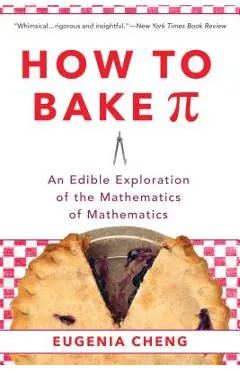
How to Bake Pi: An Edible Exploration of the Mathematics of Mathematics
nOne of the world's most creative mathematicians finds the meaning of mathematics in the kitchen in this whimsical...rigorous and insightful (New York Times) book nWhat is math?
Încă îl urmărimCum s-a mișcat prețul
Ce am observat noi
la minimToate cifrele de mai sus ies din ce am notat noi, în fiecare noapte. Nu le-am luat de nicăieri.
În fiecare zi luăm cel mai mic preț dintre toate magazinele și îl punem pe grafic. Linia verde e cel mai jos a coborât în ultima lună.
Lasă-ne adresa și îți scriem dacă scade sub —. Un singur e-mail, când chiar se întâmplă ceva. Îți cerem întâi o confirmare, și te poți retrage oricând dintr-un click.
Ce zice magazinul despre el
nOne of the world's most creative mathematicians finds the meaning of mathematics in the kitchen in this whimsical...rigorous and insightful (New York Times) book nWhat is math? How exactly does it work? And what do three siblings trying to share a cake have to do with it? In How to Bake Pi, math professor Eugenia Cheng provides an accessible introduction to the logic and beauty of mathematics, powered, unexpectedly, by insights from the kitchen. We learn how the bechamel in a lasagna can be a lot like the number five, and why making a good custard proves that math is easy but life is hard. At the heart of it all is Cheng's work on category theory, a cutting-edge mathematics of mathematics, that is about figuring out how math works. nCombined with her infectious enthusiasm for cooking and true zest for life, Cheng's perspective on math is a funny journey through a vast territory no popular book on math has explored before. So, what is math? Let's look for the answer in the kitchen. nWhat is math? How exactly does it work? And what do three siblings trying to share a cake have to do with it? In How to Bake Pi, math professor Eugenia Cheng provides an accessible introduction to the logic and beauty of mathematics, powered, unexpectedly, by insights from the kitchen: we learn, for example, how the b (c)amel in a lasagna can be a lot like the number 5, and why making a good custard proves that math is easy but life is hard. Of course, it's not all about cooking; we'll also run the New York and Chicago marathons, take a closer look at St. Paul's Cathedral, pay visits to Cinderella and Lewis Carroll, and even get to the bottom of why we think of a tomato as a vegetable. At the heart of it all is Cheng's work on category theory, a cutting-edge mathematics of mathematics, that is about figuring out how math works. This is not the math of our high school classes: seen through category theory, mathematics becomes less about numbers and formulas and more about how we know, believe, and understand anything, including whether our brother took too much cake. Many of us think that math is hard, but, as Cheng makes clear, math is actually designed to make difficult things easier. Combined with her infectious enthusiasm for cooking and a true zest for life, Cheng's perspective on math becomes this singular book: a funny, lively, and clear journey through a vast territory no popular book on math has explored before. How to Bake Pi offers a whole new way to t
Descrierea e luată de la Libris.
Alte cărți de Eugenia Cheng
Produse similare din Științe & tehnică
Vezi categoria →