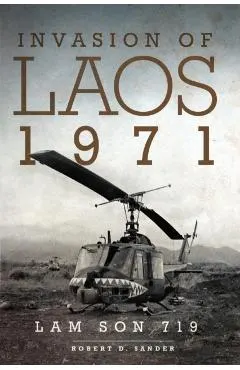
Invasion of Laos, 1971: Lam Son 719
n nIn 1971, while U.S. ground forces were prohibited from crossing the Laotian border, a South Vietnamese Army corps, with U.S.
Încă îl urmărimCum s-a mișcat prețul
Ce am observat noi
la minimToate cifrele de mai sus ies din ce am notat noi, în fiecare noapte. Nu le-am luat de nicăieri.
În fiecare zi luăm cel mai mic preț dintre toate magazinele și îl punem pe grafic. Linia verde e cel mai jos a coborât în ultima lună.
Lasă-ne adresa și îți scriem dacă scade sub —. Un singur e-mail, când chiar se întâmplă ceva. Îți cerem întâi o confirmare, și te poți retrage oricând dintr-un click.
Ce zice magazinul despre el
n nIn 1971, while U.S. ground forces were prohibited from crossing the Laotian border, a South Vietnamese Army corps, with U.S. air support, launched the largest airmobile operation in the history of warfare, Lam Son 719. The objective: to sever the North Vietnamese Army's main logistical artery, the Ho Chi Minh Trail, at its hub, Tchepone in Laos, an operation that, according to General Creighton Abrams, could have been the decisive battle of the war, hastening the withdrawal of U.S. forces and ensuring the survival of South Vietnam. The outcome: defeat of the South Vietnamese Army and heavy losses of U.S. helicopters and aircrews, but a successful preemptive strike that met President Nixon's near-term political objectives.n nAuthor Robert Sander, a helicopter pilot in Lam Son 719, explores why an operation of such importance failed. Drawing on archives and interviews, and firsthand testimony and reports, Sander chronicles not only the planning and execution of the operation but also the maneuvers of the bastions of political and military power during the ten-year effort to end Communist infiltration of South Vietnam leading up to Lam Son 719. The result is a picture from disparate perspectives: the Kennedy, Johnson, and Nixon administrations; the South Vietnamese government led by President Nguyen Van Thieu; and senior U.S. military commanders and army aviators.n nSander's conclusion is at once powerful and persuasively clear. Lam Son 719 was doomed in both the planning and execution--a casualty of domestic and international politics, flawed assumptions, incompetent execution, and the resolve of the North Vietnamese Army. A powerful work of military and political history, this book offers eloquent testimony that failure, like success, cannot be measured in absolute terms.n
Descrierea e luată de la Libris.
Produse similare din Istorie & societate
Vezi categoria →