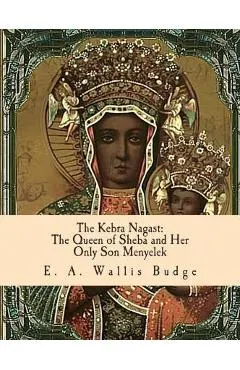
The Kebra Nagast: The Queen of Sheba and Her Only Son Menyelek
nWhat did Jamaican reggae singer Bob Marley and Emperor Haile Selassie I of Ethiopia have in common?
Încă îl urmărimCum s-a mișcat prețul
Ce am observat noi
la minimToate cifrele de mai sus ies din ce am notat noi, în fiecare noapte. Nu le-am luat de nicăieri.
În fiecare zi luăm cel mai mic preț dintre toate magazinele și îl punem pe grafic. Linia verde e cel mai jos a coborât în ultima lună.
Lasă-ne adresa și îți scriem dacă scade sub —. Un singur e-mail, când chiar se întâmplă ceva. Îți cerem întâi o confirmare, și te poți retrage oricând dintr-un click.
Ce zice magazinul despre el
nWhat did Jamaican reggae singer Bob Marley and Emperor Haile Selassie I of Ethiopia have in common? A love for the Kebra Negast, holy book of Ethiopian Christians and Jamaican Rastafarians. Contemporary scholars date the Kebra Negast to the 14th century, but it retells the stories of much earlier Biblical times, one very important story in particular. According to the Kebra Negast, the Israelites' Ark of the Covenant was spirited away to the ancient kingdom of Ethiopia by wise King Solomon's own son, offspring of the union between Solomon and the exotic Queen Makeda of Ethiopia (a.k.a. the Queen of Sheba). Gerald Hausman, a consummate storyteller of native traditions, presents the core narrative of the Kebra Negast, from Adam to the rise of the Ethiopian Solomonid dynasty. On top of this, he injects his own encounters with Rastafarians during his travels in Jamaica--dreadlocked Rastas as modern-day Samsons, their unwavering faith in Jah, and a rare outsider's glimpse at the Nyabinghi ceremony. The Kebra Nagast, or the Book of the Glory of Kings, is an account written in Ge'ez of the origins of the Solomonic line of the Emperors of Ethiopia. The text, in its existing form, is at least seven hundred years old, and is considered by many Ethiopian Christians and Rastafarians to be an inspired and a reliable account. Not only does it contain an account of how the Queen of Sheba met Solomon, and about how the Ark of the Covenant came to Ethiopia with Menelik I, but contains an account of the conversion of the Ethiopians from the worship of the sun, moon, and stars to that of the Lord God of Israel. As Edward Ullendorff explained in the 1967 Schweich Lectures, The Kebra Nagast is not merely a literary work, but it is the repository of Ethiopian national and religious feelings. According to the colophon attached to most of the existing copies, the Kebra Nagast originally was written in Coptic, then translated into Arabic in the Year of Mercy 409 (dated to AD 1225) by a team of Ethiopian clerics during the office of Abuna Abba Giyorgis, and finally into Ge'ez at the command of the governor of Enderta province Ya'ibika Igzi'. Based on the testimony of this colophon, Conti Rossini, Littmann, and Cerulli, inter alios, have marked off the period 1314 to 1321-1322 for the composition of the book.. Marcus, (1994), indicated that the religious epic story was conflated in the fourteenth century by six Tigrayan scribes. Other sources put it as a work of the fourte
Descrierea e luată de la Libris.
Produse similare din Istorie & societate
Vezi categoria →