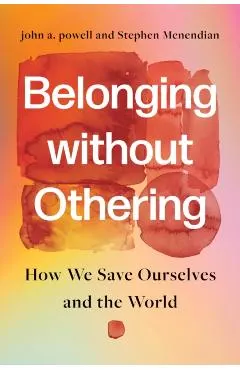
Belonging Without Othering: How We Save Ourselves and the World
nIn a world marked by extreme divisions-from global conflicts to grave human rights violations-public figures struggle to find words that capture humanity's inclination to fracture itself.
A fost și mai ieftin — l-am prins la 187,13 leiCum s-a mișcat prețul
Ce am observat noi
peste minimToate cifrele de mai sus ies din ce am notat noi, în fiecare noapte. Nu le-am luat de nicăieri.
În fiecare zi luăm cel mai mic preț dintre toate magazinele și îl punem pe grafic. Linia verde e cel mai jos a coborât în ultima lună.
Lasă-ne adresa și îți scriem dacă scade sub —. Un singur e-mail, când chiar se întâmplă ceva. Îți cerem întâi o confirmare, și te poți retrage oricând dintr-un click.
Ce zice magazinul despre el
nIn a world marked by extreme divisions-from global conflicts to grave human rights violations-public figures struggle to find words that capture humanity's inclination to fracture itself. Throughout history, humanity has been plagued by unspeakable horrors like slavery, colonialism, the Holocaust, rampant refugee crises, femicide, and state brutality, all rooted in the belief in an irreconcilable other. We yearn for a language that is capacious enough to make sense of all kinds of oppressions-whether tied to religion, ethnicity, ancestry, sexual orientation, ability, or gender. Terms like tribalism, prejudice, stigma, and caste have all been used to ignite change. They all, however, fall short.n nBelonging without Othering is a profound exploration arguing that the struggles faced by marginalized groups can only be fully grasped through the lenses of othering and belonging. Social justice lion and scholar john a. powell, and acclaimed researcher Stephen Menendian, the main champions of these ideas, unearth the mechanisms of othering, drawing on examples from around the world and throughout history. In a time when diversity, equity, and inclusion initiatives are being contested, and activists narrowly concentrate on specific and sometimes conflicting communities, this book offers an approach that encourages us to turn toward one another-even if it involves questioning seemingly tolerant and benevolent forms of othering. Crucially, the authors assert that there's no inherent or inevitable notion of an other. n nThe authors make a compelling case for a true belongingness paradigm, one that liberates us from rigid self-concepts while celebrating our rich diversity. This paradigm hinges on transitioning from narrow to expansive identities that bind people together in unprecedented ways. As the threat of authoritarianism grows across the globe, powell and Menendian make the case that belonging without othering is the natural but not the inevitable next step of our long journey toward creating truly equitable democracies. n
Descrierea e luată de la Libris.
Produse similare din Drept & administrație
Vezi categoria →