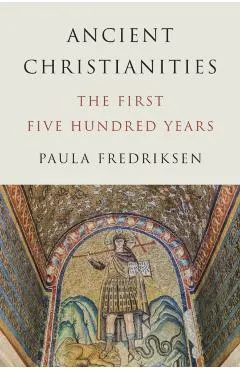
Ancient Christianities: The First Five Hundred Years
nHow, over the course of five centuries, one particular god and one particular Christianity came to dominate late Roman imperial politics and piety n nThe ancient Mediterranean teemed with gods.
A fost și mai ieftin — l-am prins la 110,91 leiCum s-a mișcat prețul
Ce am observat noi
peste minimToate cifrele de mai sus ies din ce am notat noi, în fiecare noapte. Nu le-am luat de nicăieri.
În fiecare zi luăm cel mai mic preț dintre toate magazinele și îl punem pe grafic. Linia verde e cel mai jos a coborât în ultima lună.
Lasă-ne adresa și îți scriem dacă scade sub —. Un singur e-mail, când chiar se întâmplă ceva. Îți cerem întâi o confirmare, și te poți retrage oricând dintr-un click.
Ediții identificate (2)
Ce zice magazinul despre el
nHow, over the course of five centuries, one particular god and one particular Christianity came to dominate late Roman imperial politics and piety n nThe ancient Mediterranean teemed with gods. For centuries, a practical religious pluralism prevailed. How, then, did one particular god come to dominate the politics and piety of the late Roman Empire? In Ancient Christianities, Paula Fredriksen traces the evolution of early Christianity--or rather, of early Christianities--through five centuries of Empire, mapping its pathways from the hills of Judea to the halls of Rome and Constantinople. It is a story with a sprawling cast of characters: not only theologians, bishops, and emperors, but also gods and demons, angels and magicians, astrologers and ascetics, saints and heretics, aristocratic patrons and millenarian enthusiasts. All played their part in the development of what became and remains an energetically diverse biblical religion. n nThe New Testament, as we know it, represents only a small selection of the many gospels, letters, acts of apostles, and revelations that circulated before the establishment of the imperial church. It tells how the gospel passed from Jesus, to the apostles, thence to Paul. But by using our peripheral vision, by looking to noncanonical and paracanonical texts, by availing ourselves of information derived from papyri, inscriptions, and archaeology, we can see a different, richer, much less linear story emerging. Fredriksen brings together these many sources to reconstruct the lively interactions of pagans, Jews, and Christians, tracing the conversions of Christianity from an energetic form of Jewish messianism to an arm of the late Roman state.n
Descrierea e luată de la Libris.
Alte cărți de Paula Fredriksen
Produse similare din Religie & spiritualitate
Vezi categoria →