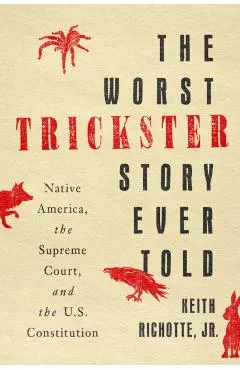
The Worst Trickster Story Ever Told: Native America, the Supreme Court, and the U.S. Constitution
The story they have chosen to tell is wrong.
Încă îl urmărimCum s-a mișcat prețul
Ce am observat noi
la minimToate cifrele de mai sus ies din ce am notat noi, în fiecare noapte. Nu le-am luat de nicăieri.
În fiecare zi luăm cel mai mic preț dintre toate magazinele și îl punem pe grafic. Linia verde e cel mai jos a coborât în ultima lună.
Lasă-ne adresa și îți scriem dacă scade sub —. Un singur e-mail, când chiar se întâmplă ceva. Îți cerem întâi o confirmare, și te poți retrage oricând dintr-un click.
Ce zice magazinul despre el
The story they have chosen to tell is wrong. It is time to tell a better story. Keith Richotte begins his playful, unconventional look at Native American and Supreme Court history with a question: When did plenary power - the federal government's self-appointed, essentially limitless authority over Native America - become constitutional? When the Supreme Court first embraced this massive federal authority in the 1880s it did not bother to seek any legal justification for the decision - it was simply rooted in racist ideas about tribal nations. By the 21st century, however, the Supreme Court began telling a different story, with opinions crediting the U.S. Constitution as the explicit source of federal plenary power, despite the lack of any textual evidence in support. So, when did the Supreme Court change its story? Just as importantly, why did it change its story? And what does this change mean for Native America, the Supreme Court, and the rule of law? In a unique twist on legal and Native history, Richotte uses the genre of trickster stories to uncover the answers to these questions and offer an alternative understanding. The Worst Trickster Story Ever Told provides an irreverent, entertaining synthesis of Native American legal history across more than 100 years, reflecting on race, power, and sovereignty along the way. By embracing the subtle, winking wisdom of trickster stories, and centering the Indigenous perspective, Richotte opens up new avenues for understanding this history. We are able, then, to imagine a future that is more just, equitable, and that better fulfills the text and the spirit of the Constitution. nWhen did the federal government's self-appointed, essentially limitless authority over Native America become constitutional? The story they have chosen to tell is wrong. It is time to tell a better story. Thus begins Keith Richotte's playful, unconventional look at Native American and Supreme Court history. At the center of his account is the mystery of a massive federal authority called plenary power. When the Supreme Court first embraced plenary power in the 1880s it did not bother to seek any legal justification for the decision - it was simply rooted in racist ideas about tribal nations. By the 21st century, however, the Supreme Court was telling a different story, with opinions crediting the U.S. Constitution as the explicit source of federal plenary power. So, when did the Supreme Court change its story? Just as importantly, why<
Descrierea e luată de la Libris.
Produse similare din Drept & administrație
Vezi categoria →