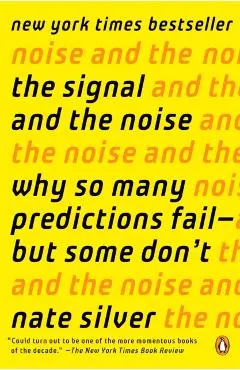
The Signal and the Noise: Why So Many Predictions Fail--But Some Don't
nOne of the more momentous books of the decade.--The New York Times Book Review Nate Silver built an innovative system for predicting baseball performance, predicted the 2008 election within a hair's breadth, a
La cel mai bun preț din ultima lună (129,60 lei)Cum s-a mișcat prețul
Ce am observat noi
la minimToate cifrele de mai sus ies din ce am notat noi, în fiecare noapte. Nu le-am luat de nicăieri.
În fiecare zi luăm cel mai mic preț dintre toate magazinele și îl punem pe grafic. Linia verde e cel mai jos a coborât în ultima lună.
Lasă-ne adresa și îți scriem dacă scade sub 129,60 lei. Un singur e-mail, când chiar se întâmplă ceva. Îți cerem întâi o confirmare, și te poți retrage oricând dintr-un click.
Întrebări frecvente
Este reducerea la The Signal and the Noise: Why So Many Predictions Fail--But Some Don't una reală?
Nu chiar. Costă 129,60 lei, adică exact cât l-am văzut cel mai ieftin în ultima lună. Nu e o scădere nouă — dar nici nu plătești mai mult decât cei care au prins momentul bun.
Care a fost cel mai mic preț la The Signal and the Noise: Why So Many Predictions Fail--But Some Don't?
Cel mai ieftin l-am prins la 115,20 lei, prima dată pe 30 iulie 2026. Îl urmărim de 62 zile.
Ce zice magazinul despre el
nOne of the more momentous books of the decade.--The New York Times Book Review Nate Silver built an innovative system for predicting baseball performance, predicted the 2008 election within a hair's breadth, and became a national sensation as a blogger--all by the time he was thirty. He solidified his standing as the nation's foremost political forecaster with his near perfect prediction of the 2012 election. Silver is the founder and editor in chief of the website FiveThirtyEight. Drawing on his own groundbreaking work, Silver examines the world of prediction, investigating how we can distinguish a true signal from a universe of noisy data. Most predictions fail, often at great cost to society, because most of us have a poor understanding of probability and uncertainty. Both experts and laypeople mistake more confident predictions for more accurate ones. But overconfidence is often the reason for failure. If our appreciation of uncertainty improves, our predictions can get better too. This is the prediction paradox The more humility we have about our ability to make predictions, the more successful we can be in planning for the future. In keeping with his own aim to seek truth from data, Silver visits the most successful forecasters in a range of areas, from hurricanes to baseball to global pandemics, from the poker table to the stock market, from Capitol Hill to the NBA. He explains and evaluates how these forecasters think and what bonds they share. What lies behind their success? Are they good--or just lucky? What patterns have they unraveled? And are their forecasts really right? He explores unanticipated commonalities and exposes unexpected juxtapositions. And sometimes, it is not so much how good a prediction is in an absolute sense that matters but how good it is relative to the competition. In other cases, prediction is still a very rudimentary--and dangerous--science. Silver observes that the most accurate forecasters tend to have a superior command of probability, and they tend to be both humble and hardworking. They distinguish the predictable from the unpredictable, and they notice a thousand little details that lead them closer to the truth. Because of their appreciation of probability, they can distinguish the signal from the noise. With everything from the health of the global economy to our ability to fight terrorism dependent on the quality of our predictions, Nate Silver's insights are an essential read.
Descrierea e luată de la Libris.
Alte cărți de Nate Silver


Produse similare din Științe & tehnică
Vezi categoria →