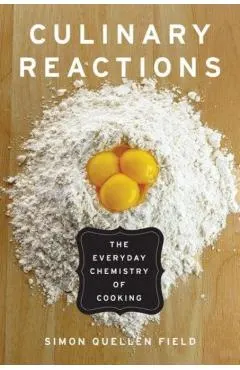
Culinary Reactions: The Everyday Chemistry of Cooking
nWhen you're cooking, you're a chemist Every time you follow or modify a recipe, you are experimenting with acids and bases, emulsions and suspensions, gels and foams.
Încă îl urmărimCum s-a mișcat prețul
Ce am observat noi
la minimToate cifrele de mai sus ies din ce am notat noi, în fiecare noapte. Nu le-am luat de nicăieri.
În fiecare zi luăm cel mai mic preț dintre toate magazinele și îl punem pe grafic. Linia verde e cel mai jos a coborât în ultima lună.
Lasă-ne adresa și îți scriem dacă scade sub —. Un singur e-mail, când chiar se întâmplă ceva. Îți cerem întâi o confirmare, și te poți retrage oricând dintr-un click.
Ce zice magazinul despre el
nWhen you're cooking, you're a chemist Every time you follow or modify a recipe, you are experimenting with acids and bases, emulsions and suspensions, gels and foams. In your kitchen you denature proteins, crystallize compounds, react enzymes with substrates, and nurture desired microbial life while suppressing harmful bacteria and fungi. And unlike in a laboratory, you can eat your experiments to verify your hypotheses. n nIn Culinary Reactions, author Simon Quellen Field turns measuring cups, stovetop burners, and mixing bowls into graduated cylinders, Bunsen burners, and beakers. How does altering the ratio of flour, sugar, yeast, salt, butter, and water affect how high bread rises? Why is whipped cream made with nitrous oxide rather than the more common carbon dioxide? And why does Hollandaise sauce call for clarified butter? This easy-to-follow primer even includes recipes to demonstrate the concepts being discussed, including: Whipped Creamsicle Topping--a foam; Cherry Dream Cheese--a protein gle; Lemonade with Chameleon Eggs--an acid indicator; and more
Descrierea e luată de la Libris.
Produse similare din Științe & tehnică
Vezi categoria →