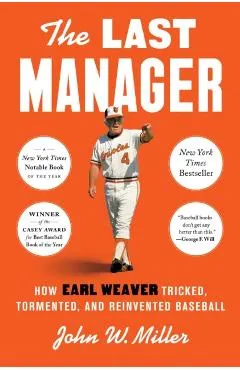
The Last Manager: How Earl Weaver Tricked, Tormented, and Reinvented Baseball
Baseball books don't get any better than this...Earl Weaver has at last been given his due.
A fost și mai ieftin — l-am prins la 148,80 leiCum s-a mișcat prețul
Ce am observat noi
peste minimToate cifrele de mai sus ies din ce am notat noi, în fiecare noapte. Nu le-am luat de nicăieri.
În fiecare zi luăm cel mai mic preț dintre toate magazinele și îl punem pe grafic. Linia verde e cel mai jos a coborât în ultima lună.
Lasă-ne adresa și îți scriem dacă scade sub —. Un singur e-mail, când chiar se întâmplă ceva. Îți cerem întâi o confirmare, și te poți retrage oricând dintr-un click.
Ce zice magazinul despre el
Baseball books don't get any better than this...Earl Weaver has at last been given his due. --George F. Will The first major biography of legendary Baltimore Orioles manager Earl Weaver--who has been described as the Copernicus of baseball and the grandfather of the modern game--The Last Manager is a wild, thrilling, and hilarious ride with baseball's most underappreciated genius, and one of its greatest characters. Long before the Moneyball-era, the Earl of Baltimore reigned over baseball. History's feistiest and most colorful manager, Earl Weaver transformed the sport by collecting and analyzing data in visionary ways, ultimately winning more games than anybody else during his time running the Orioles from 1968-1982. When Weaver was hired by the Orioles, managers were still seen as coaches and inspirational leaders, more teachers of the game than strategists. Weaver invented new ways of building baseball teams, prioritizing on-base average, elite defense, and strike throwing. Weaver was the first manager to use a modern radar gun, and he pioneered the use of analytical data. By moving 6'4 Cal Ripken, Jr. to shortstop, Weaver paved the way for a generation of plus-sized superstar shortstops, including Alex Rodriguez and Derek Jeter. He foreshadowed almost everything that Bill James, Billy Beane, Theo Epstein, and hundreds of other big brain baseball types would later present as innovation. Beyond being a great baseball mind, Weaver was a rare baseball character. Major League Baseball is show business, and Weaver understood how much of his job was entertainment. Weaver's outbursts offered players cathartic relief from their own frustration, signaled his concern for the team, and fired up fans. In his frequent arguments with umpires, he hammed it up for the crowds, faked heart attacks, ripped bases out of the ground, and pretended to toss umpires out of the game. Weaver also fought with his players, especially Jim Palmer, but that creative tension contributed to a stunning success, and a hilarious clubhouse. During his tenure as major league manager, the Orioles won the American League pennant in 1969, 1970, 1971, and 1979, each time winning over 100 games. The Last Manager uncovers the story of Weaver's St. Louis childhood with a mobster uncle, his years of minor league heartbreak, and his unlikely road to becoming a big league manager, while tracing the evolution of the game from the old-time baseball of cross-country trains and desk contracts to
Descrierea e luată de la Libris.
Produse similare din Diverse
Vezi categoria →