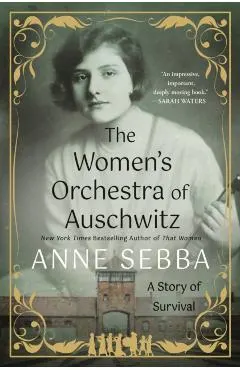
The Women's Orchestra of Auschwitz: A Story of Survival
nMoving and powerful, this is a vivid portrait of the women who came together to form an orchestra in order to survive the horrors of Auschwitz.
Încă îl urmărimCum s-a mișcat prețul
Ce am observat noi
la minimToate cifrele de mai sus ies din ce am notat noi, în fiecare noapte. Nu le-am luat de nicăieri.
În fiecare zi luăm cel mai mic preț dintre toate magazinele și îl punem pe grafic. Linia verde e cel mai jos a coborât în ultima lună.
Lasă-ne adresa și îți scriem dacă scade sub —. Un singur e-mail, când chiar se întâmplă ceva. Îți cerem întâi o confirmare, și te poți retrage oricând dintr-un click.
Ce zice magazinul despre el
nMoving and powerful, this is a vivid portrait of the women who came together to form an orchestra in order to survive the horrors of Auschwitz. n nNew York Times bestselling author of Les Parisiennes and That Woman: A Life of Wallis Simpson now examines how a disparate band of young girls struggled to overcome differences and little musical knowledge to please the often-sadistic Nazi overseers. n nIn 1943, German SS officers in charge of Auschwitz-Birkenau ordered that an orchestra be formed among the female prisoners. Almost fifty women and girls from eleven nations were drafted into a band that would play in all weathers marching music to other inmates, forced laborers who left each morning and returned, exhausted and often broken, at the end of the day. While still living amid the harshest of circumstances, with little more than a bowl of soup to eat, they were also made to give weekly concerts for Nazi officers, and individual members were sometimes summoned to give solo performances. For almost all of the musicians chosen to take part, being in the orchestra saved their lives. But at what cost? n n What role could music play in a death camp? What was the effect on those women who owed their survival to their participation in a Nazi propaganda project? And how did it feel to be forced to provide solace to the perpetrators of a genocide that claimed the lives of their family and friends? In The Women's Orchestra of Auschwitz, award-winning historian Anne Sebba traces these tangled questions of deep moral complexity with sensitivity and care. n n From Alma Rosé, the orchestra's main conductor, niece of Gustav Mahler and a formidable pre-war celebrity violinist, to Anita Lasker-Wallfisch, its teenage cellist and last surviving member, Sebba draws on meticulous archival research and exclusive first-hand accounts to tell the full and astonishing story of the orchestra, its members, and the response of other prisoners for the first time.n
Descrierea e luată de la Libris.
Produse similare din Istorie & societate
Vezi categoria →