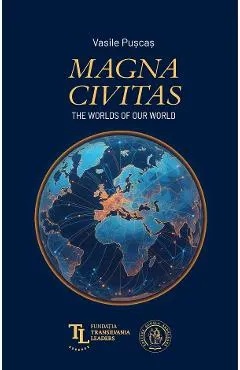
Magna Civitas. The Worlds of Our World
La minimul din 30 de zileCel mai bun preț din fiecare magazin
| Magazin | Preț | Istoric | |
|---|---|---|---|
LB Libris ISBN 9786303143392 |
59,50 lei | la minimul propriu | Vezi în magazin |
Prețurile sunt preluate automat din feed-urile magazinelor și pot varia; prețul valabil este cel din magazin, la finalizarea comenzii. Linkurile către magazine sunt linkuri de parteneriat — nu îți schimbă prețul și nu influențează ordinea ofertelor.
Evoluția prețului
Istoricul de preț se construiește — mai avem nevoie de câteva zile de monitorizare pentru un grafic relevant.
Graficul arată cel mai mic preț disponibil în fiecare zi, între toate magazinele monitorizate. Linia verde este minimul din ultimele 30 de zile.
Îți trimitem un e-mail când prețul scade sub 59,50 lei. Îți cerem o confirmare pe e-mail înainte de a-ți trimite orice alertă și te poți dezabona oricând.
Despre acest produs
Magna Civitas. The worlds of our world. Studies in the history of international relations n Just a few decades ago, it was said that we lived in a “world” made up of two or three “worlds”: the Western world, the Soviet sphere, and the so-called “Third World.” After the Cold War ended, a type of market-unifying globalism spread that was often associated with American unipolarism. Formulas for global governance were sought outside of the UN framework. Complex global interdependencies were considered evidence that humanity should live in a centrally governed world. However, such a scenario was not feasible. Idealism and realism in international relations are distinct paradigms with different applications. After the 2008 crisis, globalism underwent a transformation, and nation-states reaffirmed their sovereignty. The result was not a complete return to the Westphalian order but rather a reconsideration of the autonomous status of legitimate governance. Thus, globalization, interdependency, and interconnectedness have been maintained and reinvented. Nation-states have proposed revising traditional attributes, emphasized the external framework, and agreed to involve non-governmental actors in internal and international decision-making processes. For economic, financial, and managerial reasons, they have also preferred the regional associative dimension. Based on this vision of international relations, we can predict that the future international system will feature a multipolar world comprised of several worlds. In this system, the balance of power and complex interdependencies will require a functional framework. In other words, we will live in a world of worlds! - Vasile Pușcaș In Magna Civitas. The worlds of our world, Prof. Pușcaș offers with a critical eye a study of international systems from the time of the First World War to the present day: the successes and the failures. He brings to the subject years of research and study. Equally important, he brings as a balance his own years representing Romania in Washington and Brussels, where he could observe, participate and importantly contribute to the workings of interstate activity. He offers a welcome Romanian perspective too often missing in serious study of these turbulent years. This book will be an enduringly important contribution to the field. Highly recommended. - Ernest H. Latham, Jr., PhD, historian and diplomat, Washington, D.C. Magna civitas mirrors the work of a lifetime of Vasile Pușcaș who can rightly be considered one of the most outstanding political scientists of Romania and beyond. This book is a compendium of his consummate scholarly work on the history of international relations, on the course of contemporary and political-diplomatic events and on the predicament of Romania in a global and regional context. We also get a meaningful insight into his activity as an adroit political practitioner who successfully negotiated the normalization of relations with the USA and the country’s accession to the European Union. - Anneli Ute Gabanyi, PhD, political scientist, Berlin Herein lies the originality of the book we present to the reader of international and European negotiations, because in it the author enters the very heart of the way of being Europe which the EU has come to embody. Negotiation is not simply the process by which a country achieves accession to the EU, it is the everyday life of the European Union itself, lived through building consensus around small things which then give substance to great things, objectives and goals. - Alberto Gasparini, PhD, sociologist, Trieste
Descriere preluată din fișa produsului de la Libris.
Alte cărți de Vasile Puscas
Produse similare din Cărți în limbi străine
Vezi categoria →